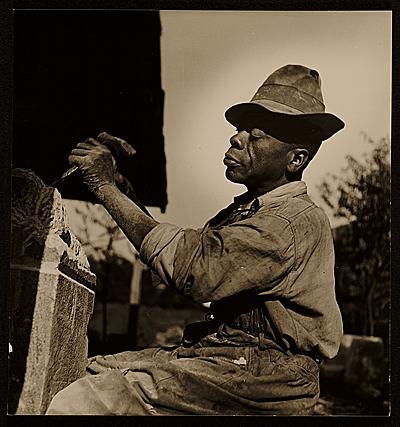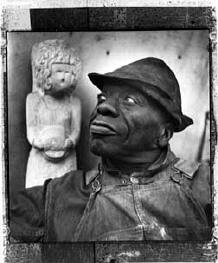
William Edmondson
Born: Nashville, TN 1874
Died: Nashville, TN 1951
“I was just doing the Lord’s work,”
“I didn’t know I was no artist until them folks come and told me I was.”
William Edmonson became the first African American artist whose work received a one-man show exhibit at MOMA. He frequently provided tombstones for members of Nashville’s Afro-American Community. Years later, his art was recognized by Sidney Hirsch, Alfred and Elizabeth Starr, and Louise Dahl-Wolfe. Dahl-Wolfe was a photographer working for Harper’s Bazaar Magazine.
She brought Edmondson’s sculptures to the attention of Alfred Barr, who was the director of the Museum of Modern Art at New York. Interest in his art waned. Appreciation for his art was revived with the 1982 show “Black Folk Art in America, 1930-1980” at the Corcoran Gallery in Washington D.C.
Highlights of His Life and Career
Divine Inspiration: In 1931, Edmondson experienced a vision where God commanded him to “pick up his tools” and carve tombstones. He often referred to his creations as “mirkels” (miracles).
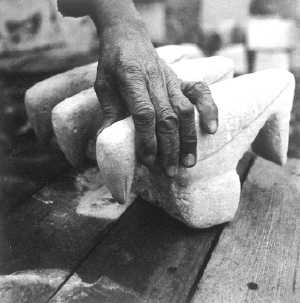
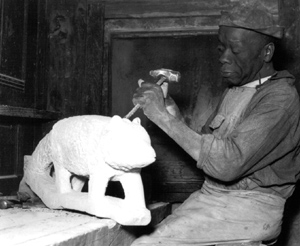
Artistic Style: Working primarily with discarded limestone from demolished buildings, he used improvised tools like chisels fashioned from railroad spikes. His work is characterized by “simple, emphatic forms” and a powerful visual economy.
Subject Matter: His repertoire began with headstones for Nashville’s Black community and expanded to include biblical figures, angels, animals (doves, squirrels), and community heroes like nurses and preachers.
National Recognition: His work was “discovered” by a local literary circle and later photographed by Louise Dahl-Wolfe, which led to his historic 1937 MoMA show.
Legacy: Though he died in relative obscurity, his sculptures are now highly prized. In 2016, his piece Boxer set a record for outsider art, selling for $785,000 at Christie’s.
Current Preservation: The William Edmondson Homesite Park & Gardens in Nashville preserves the location where he lived and worked.
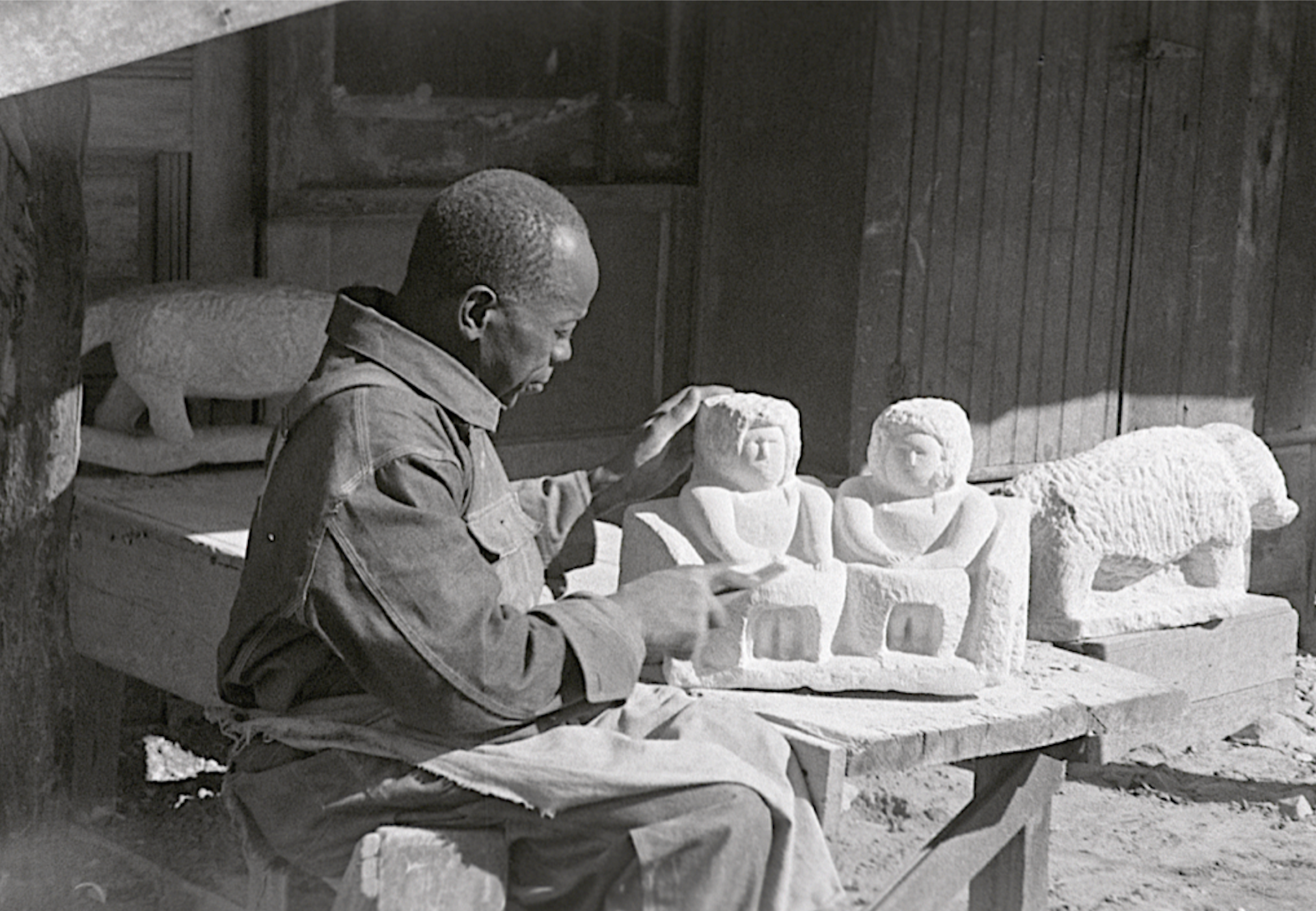
William Edmonson at work
He never learned how to read or write. (A friend taught him to make a signature on his work). His last name was the name of the farm just outside of Nashville to which he ‘belonged.’ Edmondson was born near Nashville, Tenn., around 1870. He was in his 60’s when he began to make the limestone carvings that are so highly respected today. He claimed that God had instructed him to carve.
Edmondson was born to freed slaves. He worked for the Nashville, Chattanooga and St Louis Railway for years until an accident forced him to leave the railroad. He then took a job as an orderly at an area hospital. Other jobs included a stint as a stone mason’s helper.After the hospital closed in 1931, Edmondson suddenly began carving, using blocks from a load of stone that was delivered to his home by error around the same time.
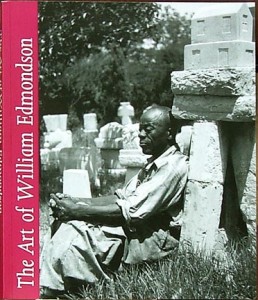 He began with simple tombstones and memorials, later extending his range to include heavenly and earthly figures in the form of garden ornaments and freestanding figural sculpture. His work played on geometric blocks and he refined them to their simplest forms; some measured between 20 and 25 inches in height. The results were austerely elegant pieces, sometimes with only the slightest suggestion of form. He often referred to his minimalist creations as “stingy.”
“I looked up in the sky and right there in the noon daylight He hung a tombstone out for me to make.”
Edmondson said the visions showed him tombstones and other shapes to carve as clearly as most people see clouds.
Metropolitan Archives of Nashville and Davidson County, Nashville
He became a convert around 1934 and attended United Primitive Church and remained dedicated to his religion. Edmondson was an active and God-fearing member of the United Primitive Baptist Church, whose teachings had a profound influence on his work. Over the 15 or so years he worked, his backyard filled up with his ethereal carved limestone likenesses of angels, biblical figures, 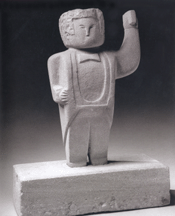 doves, preachers, women (including Eleanor Roosevelt, Little Orphan Annie, local brides and school teachers) and an entire menagerie of animal creatures and perceived varmints.
He referred to his creations as “mirkels,” miracles that God had instructed him to create. He did not give much thought to selling his work; he quietly sold his carvings from his house along with the vegetables from his garden for a few dollars. Now they sell for six figures.
Never married, he carved many figures of women and said they were all his ladies – except for a nasty-tongued former co-worker whom he carved in an exceptionally unattractive posture.
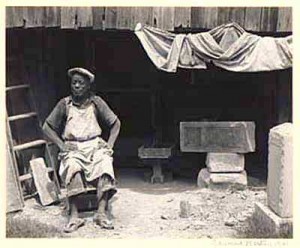
Biography
William Edmondson, son of Tennessee slaves, did not consider himself an artist when he began carving around 1932, after retiring from his job as a laborer. Inspired by a vision, he emphasized his divine calling, claiming, “Jesus has planted the seed of carving in me” and describing his works as “mirkels.” Edmondson carved gravestones, free-standing figurative sculpture, and garden ornaments, using discarded blocks of limestone and chisels fashioned from railroad spikes. Animals, biblical subjects, and secular figures like Eleanor Roosevelt and Nashville school teachers dominated his repertoire.
In several sculptures entitled Crucifixion, Edmondson celebrated Christ as the Savior, the most popular figure in the spiritual tradition of African-American art. The museum’s example [SAAM, 1981.141] is an early version, once also called Baby Jesus. Its rectangular silhouette and upright frontality suggest the gravestone tablets that Edmondson saw in his original vision. Crucifixion retains a strong sense of the block’s shape and texture in its minimally articulated form and detail. Only the emphatic curves of the lower torso reveal Edmondson’s attempt to break away from the block, suggesting that he executed Crucifixion soon after he turned from carving gravestones to more imaginative, free-standing subjects. Compact and stylized, the sculpture conveys its spiritual message with the authority and immediacy of an archaic monument.
Edmondson’s work coincided with the revival of direct carving in stone during the 1930s. Unaware of this development, he relied on divine calling and instruction, affirming his ties with other African Americans whose spirituality has provided the impetus for their art, music, and literature.
Lynda Roscoe Hartigan African-American Art: 19th and 20th-Century Selections (brochure. Washington, D.C.: National Museum of American Art)
Much has been made of Edmondson’s modernism. The delicacy of his work renders him both a modernist and a primitive artist at the same time, a style that evolved from within into a stunning abstract. His work was strongly linked to modernism. Edmondson’s career lasted for about fifteen years. During some of these years, he worked under the Works Progress Administration, a government sponsored artists’ relief program. However, he was free to create carvings of his choice. In the 1940s, his health began to fail and he developed cancer. During the last few years of his life, he worked with small blocks of limestone. He never left Tennessee. He died on February 8, 1951 in Nashville, TN. He was buried in an unmarked grave in Mt. Ararat Cemetery in Nashville.
“He consistently credited God when asked about his work and never referred to himself as an artist.”
LINKS
http://en.wikipedia.org/wiki/William_Edmondson
https://americanart.si.edu/artist/william-edmondson-1408
http://www.cheekwood.org/Art/William_Edmondson.aspx
http://www.tfaoi.com/aa/1aa/1aa219.htm
https://arrowmont.org/black-history-month-artist-spotlight-william-edmondson/
https://www.documentary.org/project/chipping-away-life-and-legacy-sculptor-william-edmondson