Hispanic and Latino Performance
on the Great White Way*
by DALE RICARDO SHIELDS

Hispanic and Latino theater history in the United States spans over 400 years, evolving from early Spanish colonial and indigenous performance traditions to vibrant modern political and commercial movements.
Early Roots and the 20th Century
• Colonial Beginnings: Performance traditions date back to the 16th century with missionary religious plays, folk theater, and indigenous ritual adaptations.
• Carpa Tents: During the early 1900s, Mexican-American communities in the Southwest enjoyed carpas—traveling tent shows featuring satirical sketches, music, and variety acts.
• Immigrant Stages: Cuban mutual aid societies and Spanish-language theater companies thrived in Florida, New York, and Los Angeles, driven by 20th-century migration
The Chicano Movement and Modern Era
• El Teatro Campesino: Founded in 1965 by Luis Valdez as the cultural arm of the United Farm Workers in California, this troupe created short, political actos to inspire social action.
• Mainstream Milestones: René Marqués’ pioneering 1953 play The Oxcart (La carreta) brought the Puerto Rican migration experience to New York stages.
• Broadway Success: Lin-Manuel Miranda’s multi-Tony-winning musical In the Heights and John Leguizamo’s solo works helped cement contemporary Latino narratives in commercial mainstream spaces.
“Latino theater presents a wide range of aesthetic approaches, dramatic structures, and themes, ranging from love, romance, immigration, border politics, nation building, incarceration, and social justice. Whether of a linguistic, ethnic, political, cultural or sexual nature, the plays often have a social justice component involving Latino people living in the United States. The Oxcart by René Marqués, Marisol by José Rivera,[4] and In the Heights[5] by Lin-Manuel Miranda are examples of staged Broadway plays. There is also a strong tradition of Latino avant-garde and absurdist theater, which double as political satires; prime examples include The Masses are Asses by Pedro Pietri and United States of Banana by Giannina Braschi.
Spanish language theater companies and in Latino theater festivals in the United States present Spanish, Spanglish, English language plays in major American cities, including New York, Chicago, Tucson, Seattle, Denver.”
🎭
~ BROADWAY ~
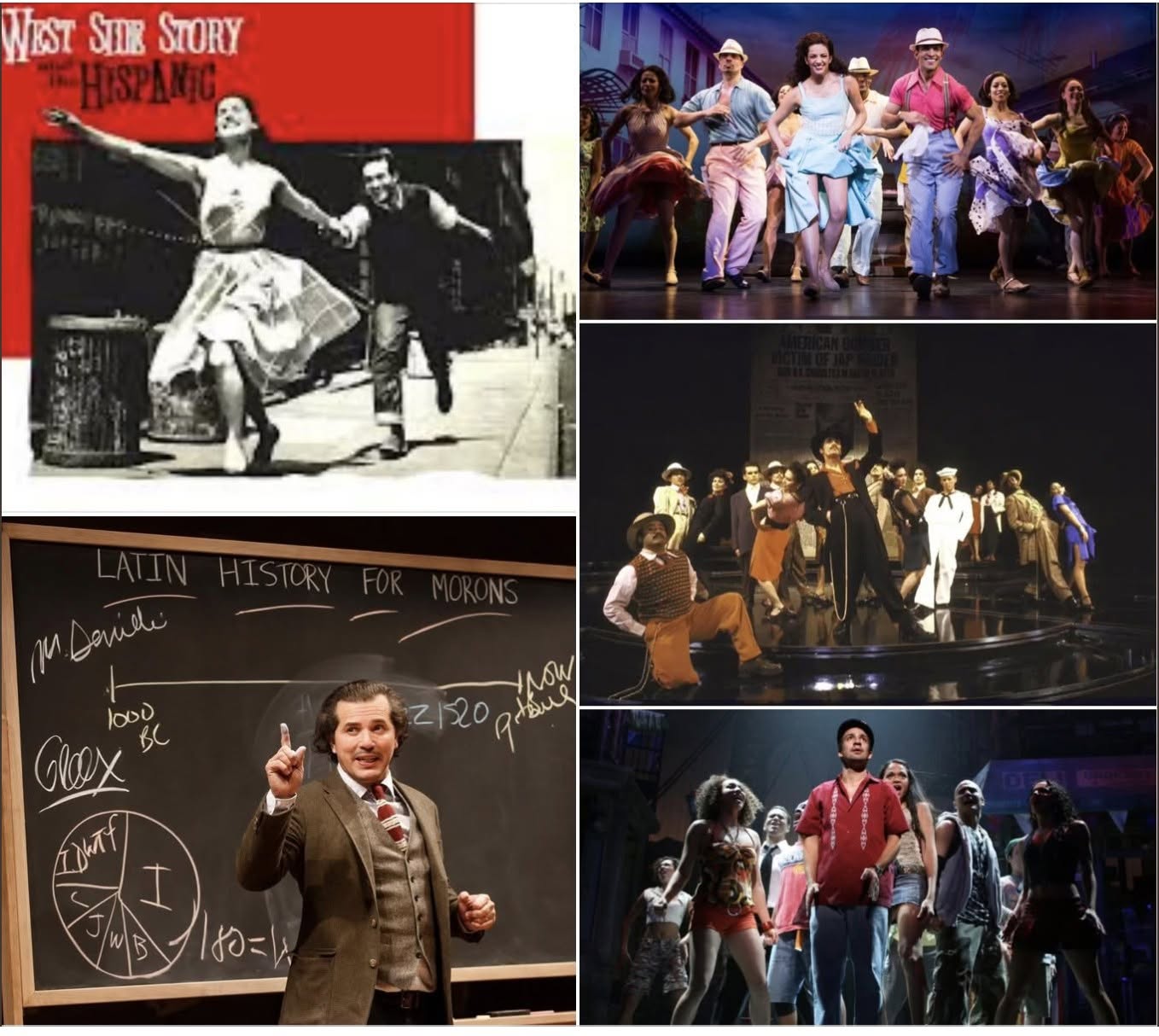
Hispanic and Latino theater history on Broadway reflects a long struggle for authentic representation, moving from early, often stereotypical portrayals to more genuine and diverse stories. [IFC]
Significant milestones include pioneering actors, groundbreaking plays, and successful musicals written and performed by Hispanic and Latino artists.
Early representation:
Exotica and stereotyping
Before the latter half of the 20th century, Hispanic and Latino representation on Broadway was limited and often relied on stereotypes.
The Good Neighbor Policy Era:
In the 1930s and 1940s, artists like Carmen Miranda and Desi Arnaz were featured in Broadway shows but often portrayed within the confines of “exuberant sexuality and spectacular racialized exoticism”.
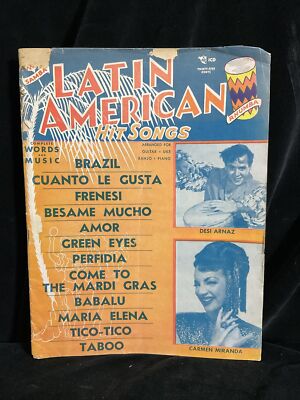
Latinos On Broadway: Rooted in Culture. Rising on Stage. | LATiNAS & THEATER: All the Moving Parts
–
🎭 * West Side Story (1957):
This classic musical is a landmark in its portrayal of Puerto Rican life in New York, but it has also been criticized for its use of stereotypes and for hiring non-Latino actors for principal roles. The original Broadway cast did, however, feature Puerto Rican actor Chita Rivera in a career-defining role as Anita.
– Pioneering artists and milestones
The mid-20th century and beyond saw significant breakthroughs for Hispanic and Latino artists and stories.
José Ferrer (1947): The Puerto Rican actor won a Tony Award for Best Actor for his role in Cyrano de Bergerac, becoming one of the first Hispanic performers to win a Tony.
🎭 * Short Eyes (1974):
Written by Puerto Rican playwright Miguel Piñero while he was an inmate at Sing Sing Prison, the play premiered on Broadway to critical acclaim and was nominated for six Tony Awards, including Best Play.
* Rita Moreno (1975):
She won a Tony Award for her performance in Terrence McNally’s The Ritz. She became the first Latina to achieve EGOT status (winning an Emmy, Grammy, Oscar, and Tony) in 1977.
🎭 * Zoot Suit (1979):
Written by Luis Valdez, this was the first Chicano play to be produced on Broadway. It explored the Sleepy Lagoon murder and the Zoot Suit Riots of the 1940s in Los Angeles, tackling issues of Chicano identity and racism.
* Nicholas Dante (1976)
As co-writer of the book for A Chorus Line, he was the first Latino to win the Pulitzer Prize for Drama.
* Graciela Daniele (1990)
The Argentine-American choreographer and director received a Tony Award for Lifetime Achievement in 2020 and has held key creative roles in many Broadway productions, including directing and choreographing Once on This Island.
– The modern era: Expanding authenticity
The 21st century has brought more nuanced and successful Hispanic and Latino stories to the Broadway stage.
🎭 * Anna in the Tropics (2003):
Nilo Cruz became the first Latino playwright to win the Pulitzer Prize for Drama for this play, which focuses on Cuban immigrants in a Florida cigar factory. It later had a run on Broadway.
🎭 * In the Heights (2008):
This groundbreaking musical with a concept, music, and lyrics by Lin-Manuel Miranda and a book by Quiara Alegría Hudes told an authentic, vibrant story of a predominantly Dominican-American community in Washington Heights. It won the Tony Award for Best Musical.
🎭 * Hamilton (2015):
Created by Lin-Manuel Miranda, this pop-culture phenomenon featured a diverse cast that provided opportunities for many Hispanic and Latino actors and won 11 Tony Awards, including Best Musical.
🎭 * On Your Feet! (2015):
This jukebox musical tells the story of Gloria Estefan and Emilio Estefan, celebrating their pop music and their Cuban heritage.
🎭* Latin History for Morons (2017):
A one-man play by John Leguizamo, it is an educational and satirical take on the underappreciated history of Latinos in the Americas.
Matthew López (2021)
He became the first Latino playwright to win the Tony Award for Best Play for his work, The Inheritance. In his acceptance speech, he called attention to the underrepresentation of the Latino community on Broadway.
–
Early Pioneers and Individual Milestones
Before Latino-written productions found a foothold on commercial stages, individual performers broke major barriers:
José Ferrer: In 1947, the Puerto Rican actor won the very first Tony Award for Best Actor in a Play for his towering performance in Cyrano de Bergerac, later adding four more Tonys to his career as an actor and director.
.
Chita Rivera & Rita Moreno: Iconic artists who challenged limited industry spaces. Moreno won a Tony in 1975 for The Ritz—later completing her legendary EGOT status—while Rivera became a defining Broadway fixture, notably starring in West Side Story (1957) and later winning acclaim in Kiss of the Spider Woman(1993).
.
Ricardo Montalbán & Anthony Quinn: Mexican-born stars who asserted their presence in major mid-century productions. Montalbán earned a Best Actor Tony nomination for Jamaica (1957) and later founded Nosotros to advocate for Latino artists, while Quinn starred as Stanley Kowalski in the original run of A Streetcar Named Desire.
Breaking the Playwriting Barrier (1970s–1980s)
For decades, Broadway presented shows about Hispanic communities (like the original West Side Story or Evita) that were constructed entirely by non-Latino creative teams, often leading to protests over authentic casting. The tide began to turn as writers took ownership of the narrative:
.
Miguel Piñero (Short Eyes, 1974): Piñero became the first known Hispanic playwright produced on Broadway when his gritty, raw drama about incarceration transferred to the Vivian Beaumont Theater, earning six Tony nominations.
.
Nicholas Dante (A Chorus Line, 1975): Co-writing the book for this legendary musical, Dante became the first Hispanic artist to write a Broadway musical and the first to win the Pulitzer Prize for Drama. He based the iconic character of Paul directly on his own life experiences.
.
Luis Valdez (Zoot Suit, 1979): Transferred from the historic El Teatro Campesino on the West Coast, Zoot Suit made history as the first Chicano-written and directed play on Broadway, directly confronting the 1943 Los Angeles riots and Mexican-American discrimination.
The fight for greater representation continues…
Despite these successes, Hispanic and Latino communities remain significantly underrepresented on Broadway, a disparity that artists and organizations are actively working to change.
The Pipeline and Solo Performance (1990s)
Commercial limitations on Broadway meant that vital structural development took place in Off-Broadway institutions, which served as a crucial pipeline. Companies like the Puerto Rican Traveling Theater, founded by Miriam Colón in 1967, gave artists the creative freedom to experiment without commercial compromise.
New Horizons:
The theatrical landscape continues to expand with contemporary productions that bring diverse international perspectives to the stage, such as the Cuban-diaspora musical Buena Vista Social Club and the immigrant-family narrative Real Women Have Curves.
– Organizations like Viva Broadway and initiatives from institutions like the New York Public Library highlight the ongoing need to celebrate and support Latino voices in theater.
*- Upcoming productions, such as the musical Real Women Have Curves, continue to push for more representative and authentic storytelling.
Iforcolor.org
Hispanic and Latino artists have built a rich legacy on Broadway, shaping American musical theater as pioneering actors, actresses, singers, and dancers. From foundational icons who broke initial barriers to contemporary powerhouses redefining the marquee, their contributions have moved the spotlight toward authentic, inclusive storytelling.
Golden Age & Trailblazing Icons
José Ferrer: The legendary Puerto Rican actor made history as the first Hispanic actor to win a Tony Award for Best Actor in Cyrano de Bergerac (1947), later becoming the first Hispanic performer to win an Academy Award.
Chita Rivera: A transcendent force in theater history, this Puerto Rican-American icon famously originated the role of Anita in the original Broadway production of West Side Story (1957). She earned two Tony Awards, ten nominations, and became the first Latina to receive the Kennedy Center Honors (2002).
Rita Moreno: The beloved Puerto Rican actress, singer, and dancer won a Tony Award for The Ritz (1975). She achieved rare EGOT status (Emmy, Grammy, Oscar, Tony) and also starred as Anita in the iconic 1961 film adaptation of West Side Story.
Diosa Costello: Referred to as “The Latin Bombshell,” the Puerto Rican performer pioneered early Latino representation on Broadway, debuting in Too Many Girls (1939) alongside Desi Arnaz and later starring as Bloody Mary in the national tour of South Pacific.
Raúl Juliá: The charismatic Puerto Rican actor commanded the Broadway stage in the 1970s and 1980s, earning four Tony Award nominations for acclaimed revivals and musicals like Two Gentlemen of Verona, Where’s Charley?, The Threepenny Opera, and Nine. He also stood out as an early marker of Latino presence in major classics like Man of La Mancha.
Contemporary Stars & Contemporary Visionaries
Lin-Manuel Miranda: The Pulitzer Prize, Grammy, and Tony Award-winning creator revolutionized modern theater by writing, composing, and starring in the groundbreaking Broadway hits In the Heights (2008) and Hamilton (2015).

Bianca Marroquín: A highly accomplished dancer and actress who made history in 2002 as the first Mexican woman to secure a leading role on Broadway as Roxie Hart in Chicago. Alongside Chita Rivera, she is one of the few performers to have transitioned to portray Velma Kelly in the same production.
Lindsay Mendez: A powerhouse vocalist and actress of Mexican descent who won a Tony Award for Best Featured Actress for her portrayal of Carrie Pipperidge in the 2018 revival of Carousel.
Anthony Ramos: A vibrant Puerto Rican-American actor and singer who rose to stardom by originating the dual roles of John Laurens and Philip Hamilton in the original Broadway cast of Hamilton (2015), later starring as Usnavi in the film adaptation of In the Heights.
Eva Noblezada: The acclaimed Filipina-Mexican actress and singer earned Tony nominations for her powerful starring turns as Kim in the 2017 revival of Miss Saigon and Eurydice in Hadestown (2019).
Danny Burstein: An esteemed veteran stage actor of Costa Rican descent, Burstein has earned seven Tony Award nominations, winning Best Featured Actor in a Musical for his role as Harold Zidler in Moulin Rouge! The Musical.
Javier Muñoz: Noted for his prominent performances in Lin-Manuel Miranda’s works, Muñoz stepped into the titular role of Alexander Hamilton on Broadway full-time after serving as Miranda’s primary understudy.
Florencia Cuenca: A prominent Mexican immigrant actor and singer who made headlines by becoming the first Mexican immigrant to originate a lead role on Broadway before obtaining U.S. citizenship, starring as Estela in the 2025 musical production of Real Women Have Curves.
Latino plays and musicals
The Capeman
Elliot, A Soldier’s Fugue (Pulitzer Finalist)
Four Guys Named Jose and Una Mujer Named Maria
Hamilton
In the Heights
Kiss of the Spider Woman
Mariso
La Pasión según Antígona Pérez, a tragedy based on the life of Olga Viscal Garriga
The Oxcart/La Carreta
On Your Feet
United States of Banana
Water by the Spoonful (2012 Pulitzer Prize winner)
West Side Story
Watsonville
The Hungry Woman Buena Vista Social Club
Latino playwrights and directors
Agustín Cuzzani
Anne García-Romero
Antón Arrufat
Caridad Svich
Carlos Lacámara
Cherríe Moraga
Dolores Prida,
Emilio Carballido
Giannina Braschi
Héctor Santiago
José Corrales
José Rivera (Marisol)
Lin-Manuel Miranda
Luis Rafael Sánchez
Luis Santeiro
Luis Valdez
Manuel Martín Jr.
Manuel Pereiras García
María Irene Fornés
María Julia Casanova
María Ruiz de Burton
Nilo Cruz
Pedro Pietri
René Marqués (The Oxcart)
Susana Cook
Rosario Vargas
C. Julian Jiménez
Carlos Gorostiza
Egon Wolff
Gabriel García Márquez,
Griselda Gambaro
Jorge Dìaz
José Triana
Luis Alberto Heiremans
Luis Alfaro
Luisa Josefina Hernández
Osvaldo Dragùn
Quiara Alegría Hudes
René Marqués
EDUCATIONAL RESEARCH – NO COPYRIGHT INFRINGEMENT INTENDED.
© DALE RICARDO SHIELDS – Iforcolor.org
PHOTOGRAPHY CREDITS:
* Under construction – Photography credits coming