~ SUMMARY
What led to the Orangeburg Massacre?
The Orangeburg Massacre on February 8, 1968, was the tragic culmination of a week-long series of protests against the segregation of All Star Bowling Lanes, the only bowling alley in Orangeburg.
The events leading up to the massacre included:
-
Segregation Conflict: Despite the Civil Rights Act of 1964, owner Harry Floyd refused to desegregate, claiming his bowling alley was a private business exempt from the law.
-
Escalating Protests: On February 5 and 6, students from South Carolina State University and Claflin University held demonstrations at the alley. On the second night, a violent confrontation occurred between students and police, during which officers beat several protesters with billy clubs, enraging the student body.
-
National Guard Mobilization: Governor Robert McNair, fearing “Black Power” agitators and urban unrest, activated the National Guard and deployed hundreds of state highway patrolmen to the city.
-
The Shooting: On the night of February 8, approximately 200 students gathered around a bonfire at the entrance of the SCSU campus. After a police officer was struck by a thrown object, highway patrolmen opened fire into the crowd of unarmed students for about eight seconds, killing Samuel Hammond Jr.,
- Acquittal of Officers: Nine South Carolina Highway Patrol officers were charged with using excessive force, but all were acquitted by a jury in 1969.
- Conviction of Cleveland Sellers: The only person imprisoned in connection to the event was SNCC activist
Cleveland Sellers
, who was wounded in the shooting. He was convicted of “inciting a riot” and served seven months in prison before being pardoned 25 years later in 1993.
- Desegregation: Following the massacre, All Star Bowling Lanes and most other remaining “whites-only” establishments in Orangeburg finally desegregated.
- Media Overshadowing: The event occurred during the Tet Offensive of the Vietnam War and was followed months later by the assassinations of Martin Luther King Jr. and Robert F. Kennedy, which pushed it out of the national news cycle.
- Misinformation: Initial media reports falsely claimed students were armed and had fired first, a narrative that persisted for years and shaped public perception.
- Educational Omission: For decades, the incident was largely excluded from civil rights history books and school curricula, leading to a long-term lack of public awareness outside of the Black community.
- Governor’s Apologies: In 2001, Governor Jim Hodges became the first state leader to attend an official memorial service and issue a formal apology. This was followed by a written apology from Governor Mark Sanford in 2003.
- Permanent Memorials: South Carolina State University established the Smith-Hammond-Middleton Legacy Plaza and a basketball arena named in their honor to ensure the tragedy is not forgotten on campus.
- Racial Divide: The lack of accountability and conflicting accounts of the night significantly inflamed racial tensions in Orangeburg for generations.
- Trauma for Survivors: Many survivors reported that the experience ended their academic careers or left them with lifelong trauma, as they were shot while fleeing and later saw their peers’ deaths go unpunished.
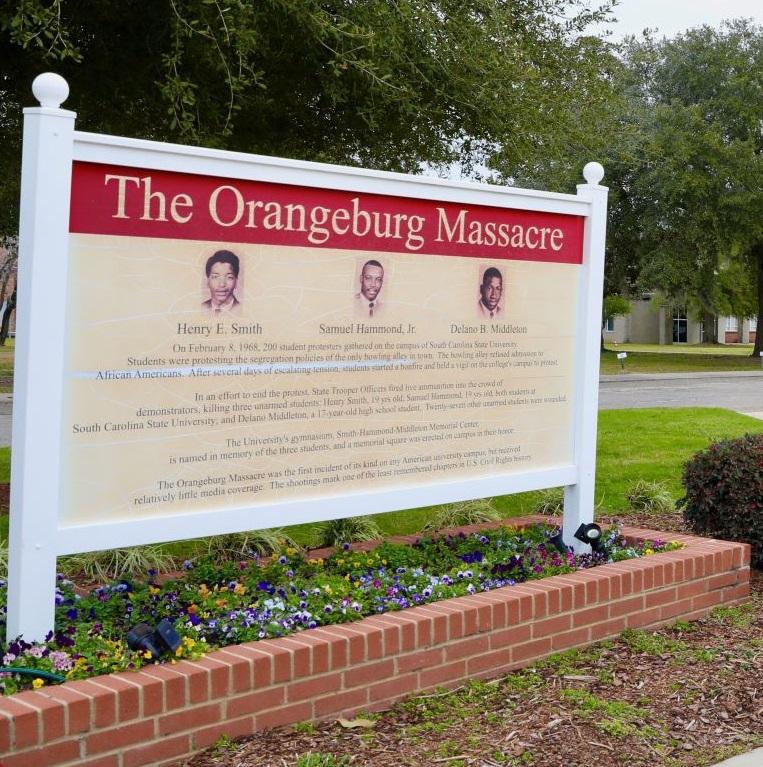
This sign is part of the Orangeburg Massacre memorial at S.C. State. (Special to The Panther)
The incident is historically significant as the first instance of law enforcement killing student protesters on an American university campus. the Orangeburg Massacre,
{The Feb. 8, 1968, incident in which three students were killed and 28 others were wounded when S.C. highway patrolmen opened fire on student protesters at S.C. State University. The protest centered around desegregation efforts at an Orangeburg bowling alley.}
LINKS
https://en.wikipedia.org/wiki/Orangeburg_Massacre
https://www.history.com/articles/orangeburg-massacre
https://scsu.edu/annual_programs/orangeburg_massacre.php
https://calendar.eji.org/racial-injustice/feb/8
https://ldhi.library.cofc.edu/exhibits/show/orangeburg-massacre/oburg-intro
https://civilrightstrail.com/attraction/orangeburg-massacre/
https://www.claflin.edu/news-events/the-panther/what-do-you-know-about-orangeburg-massacre
PHOTOGRAPHY:
CNN
Zinn Education Project
South Carolina State University
PBS
ABC NEWS
AP (Associated Press)
BlackPast.org
CivilRightsTrail
The Panther
Tyler Starks
Cecil Williams
Bill Barley
SC HUMANITIES COUNCIL
History.com
Bettmann Archive via Getty Images
Wikipedia
NO COPYRIGHT INFRINGEMENT INTENDED
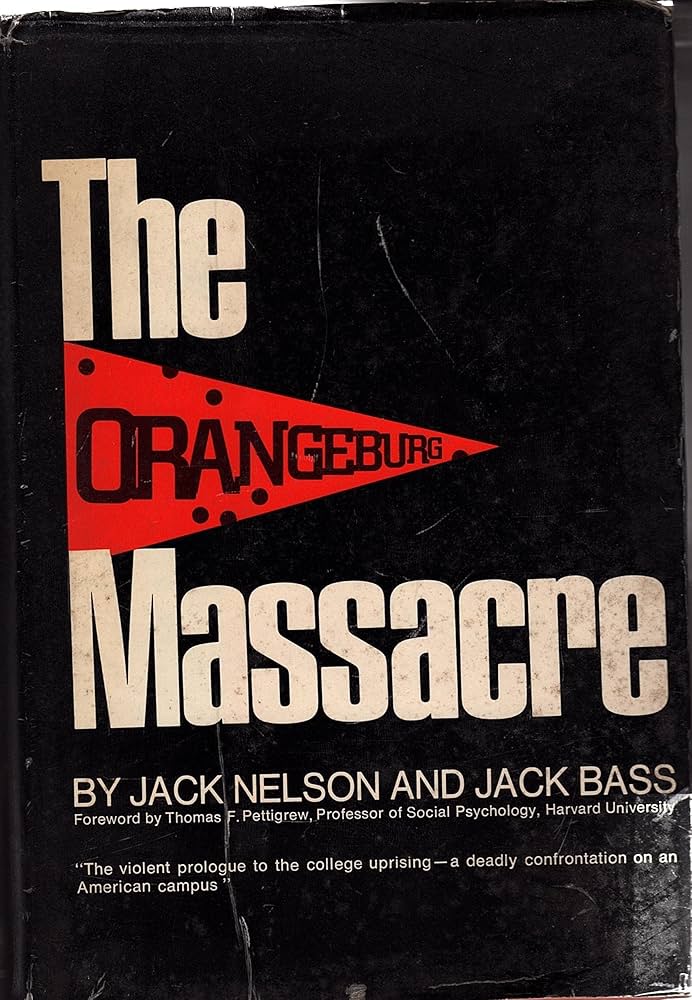
October 19, 1970 by Jack Nelson (Author), Jack Bass (Author), Thomas F. Pettigrew (Foreword)
EDUCATIONAL – NO COPYRIGHT INFRINGEMENT INTENDED
©. IFORCOLOR.ORG – DRS