LEIGH WHIPPER

Publicity still portrait of American actor Leigh Whipper (1876 – 1975) in the film ‘Of Mice and Men‘ (United Artists), 1939. (Photo by John D. Kisch/Separate Cinema Archive/Getty Images)
by Dale Ricardo Shields
Leigh Rollin Whipper
A massive figure in early American performing arts, breaking racial barriers long before the Civil Rights Movement.
The 1st Black member of Actors Equity Association.
The founder of the Negro Actors Guild and member of the
The Negro Division the Hollywood Victory Committee.
Born: (1876) Charleston, South Carolina
Died: (1975) New York City, New York
“Although a strong presence in the (still extant) Oscar Micheaux drama Symbol of the Unconquered (1920), gaunt-looking African-American performer Leigh Whipper had to wait 23 years for a second screen role truly worthy of his not inconsiderable talents, that of the preacher Sparks in The Ox-Bow Incident.
He is credited with being the first Black member of Actors Equity and the founder of the Negro Actors Guild, had done much better on Broadway, where he starred in the 1929 revival of Porgy, wrote and starred in the short-lived Yeah Man (1932), and originated the part of Crooks in Of Mice and Men (1937), a role that he re-created in the 1939 screen version.
Arguably the finest African-American actor of his generation — and one of the finest performers in the history of American theater.
He was awarded the prestigious Oscar Micheaux Award in 1974. In the 1990s, The Philadelphia International Film Festival instituted an award in his honor.”
– Hans J. Wollstein, Rovi
Leigh Whipper’s career was defined by both his powerful stage presence and his tireless advocacy for Black performers in an era of intense segregation.
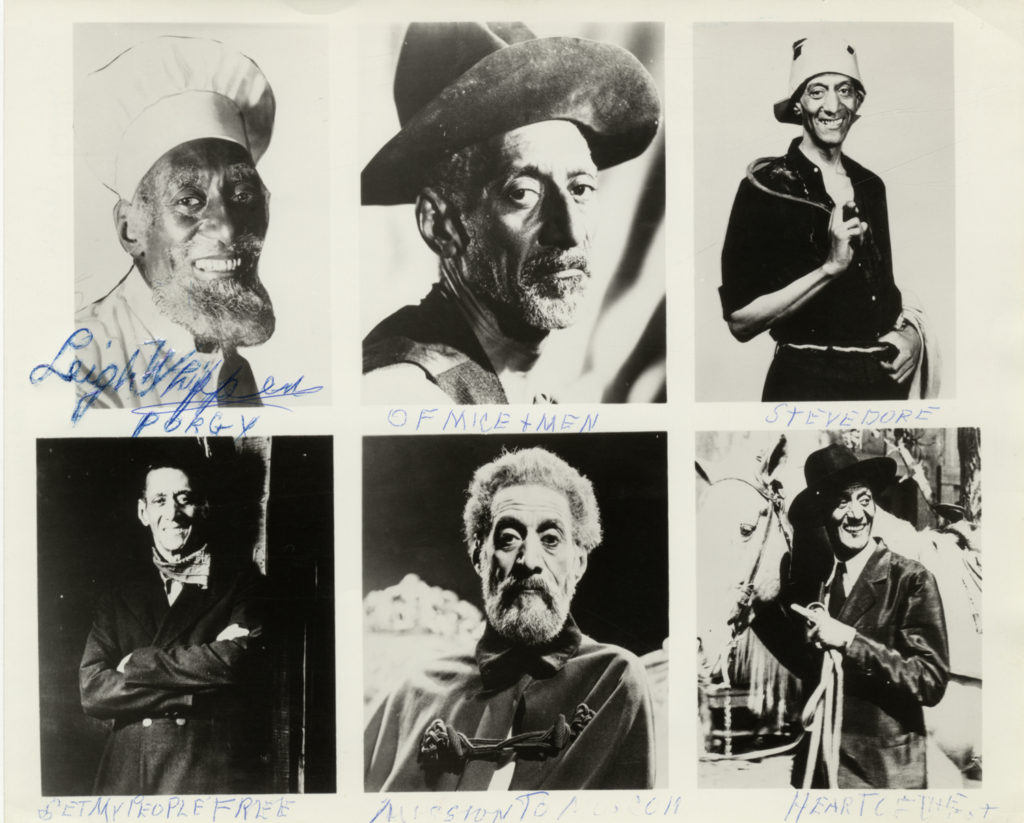
Leigh Rollin Whipper
(1876–1975)
A pioneering African American actor who broke significant racial barriers in the entertainment industry. He is most distinguished as the first Black member of the Actors’ Equity Association (joining in 1913) and a founding member of the Negro Actors Guild of America in 1937.
Career Highlights
- Stage Success: Whipper gained national fame for his role as the Crab Man in the original 1927 Broadway production of Porgy, where he introduced the “Crab Man’s Song”.
- “Of Mice and Men”: He is perhaps best known for creating the role of Crooks in the original Broadway production (1937) and reprising it in the acclaimed 1939 film.
- Film Roles: His filmography includes over 20 movies, such as The Ox-Bow Incident(1943) and Mission to Moscow (1943), for which he was honored by the Ethiopian government for his portrayal of Emperor Haile Selassie.
- Pioneer Status: Before his mainstream success, he debuted in Oscar Micheaux’ssilent race films, including Within Our Gates (1920).
Personal Background
- His Father: William J. Whipper was an African American attorney and judge during the Reconstruction era. He was a delegate to the 1868 South Carolina Constitutional Convention and a vocal advocate for women’s suffrage.
- His Mother: Frances Anne Rollin was a teacher and author who wrote the first diary by a Southern Black woman and the biography of abolitionist Martin Delany.
- The Family Legacy: This background of intellectualism and resistance heavily influenced Leigh’s later work as a labor leader for Black actors.
Broadway Highlights (1920s-1940s)
- The Heart of Maryland (1921): One of his early credited roles in a major production.
- Stevedore (1934): A highly political play where he played Jim Veal. The production was famous for its uncompromising look at labor and race.
- Of Mice and Men (1937): His most famous Broadway role as Crooks, which ran for over 200 performances and cemented his reputation as a master of naturalistic acting.
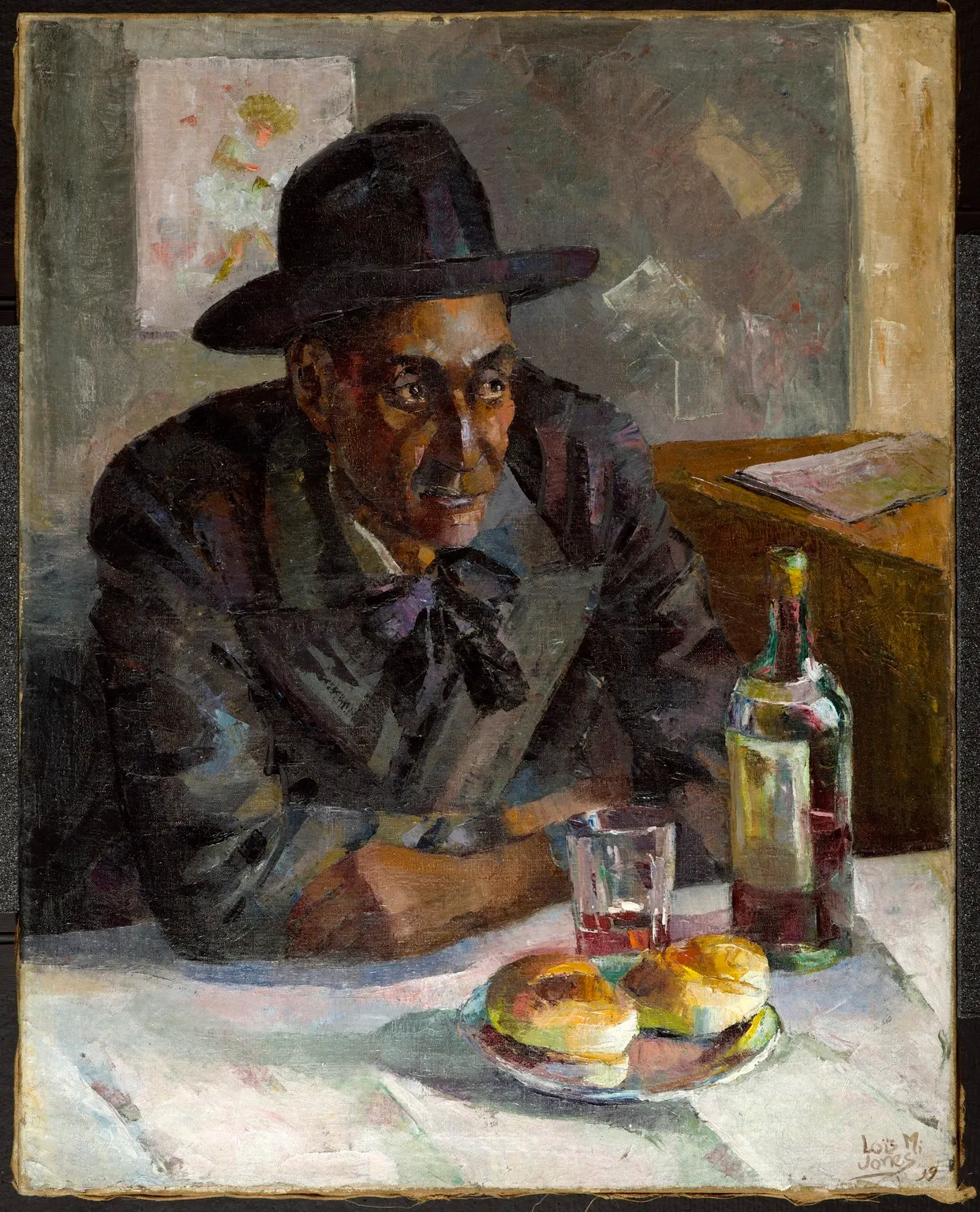
Leigh Whipper, depicted in the painting “Dans un Café a Paris” by Lois Mailou Jones (1939).
{Painting by acclaimed artist Lois Mailou Jones done in 1939 called Dans un Cafe a Paris}
Academy Award nominee Leigh Whipper (1876-1975), posing him as if he’s in a Paris cafe. Dans un Café à Paris (Leigh Whipper) 1939 (oil on canvas, collection of E. Thomas Williams Jr. and Audlyn Higgins Williams). On May 22, 2009, The Wall Street Journal quoted, “Mr. Williams, a retired banker and real estate investor, strolled through his Manhattan apartment and stopped in front of the jewel of his collection, a smoky-hued portrait of a man in a fedora (Leigh Whipper) by Loïs Mailou Jones.
The painting is appraised at $150,000.00, but he says he would happily donate it to the White House permanent collection.” Loïs considered it one of her best works and it was later shown in a Paris exhibit. Whipper was a friend of Jacob Lawrence and told her in a letter that Jake was carried away with her comment about his work. Whipper was a graduate of Howard Law School but preferred acting. He wrote in her guest book: “To the #1 Negro artist (Loïs Jones) who will someday be America’s #1 artist.”
The Harlem Renaissance Connection
Whipper was a “living dignitary” of the Harlem Renaissance, a period of cultural explosion for African American music, theater, and literature.
- Archival Legacy: In January 2026, a restored documentary titled Once Upon a Time in Harlem debuted at the Sundance Film Festival. It features 1972 footage of Whipper in conversation with other Renaissance icons like Aaron Douglas and Eubie Blake, debating the movement’s legacy.
- The “New Negro” Movement: During the 1920s and 30s, Whipper helped redefine Black identity by transitioning from minstrelsy to serious dramatic roles on Broadway.
- Collaboration: He worked alongside fellow Renaissance luminaries such as Paul Robeson and Fredi Washington, often appearing in productions that challenged racial stereotypes.
The Negro Actors Guild of America (NAG)
- Role and Leadership: Whipper was a founding member and served as its president from 1957 to 1960, succeeding Noble Sissle.
- Mission of Advocacy: Under his leadership and that of other founders (including Ethel Waters and Bill “Bojangles” Robinson), the NAG fought for:
- Realistic Depictions: They campaigned against caricatures and for more authentic roles for Black actors.
- Welfare and Support: The Guild provided critical social services, including health care, transportation, housing for traveling performers, and even financing for funerals within the Black theater community.
- Institutional Growth: By the 1940s, membership grew to over 700 people. The organization eventually dissolved in 1982 as the industry became more integrated.
- Fredi Washington: The Guild’s first executive secretary and star of the original Imitation of Life.
- Bill “Bojangles” Robinson: The world-famous tap dancer served as the Guild’s first honorary president.
- Ethel Waters: A legendary blues singer and Oscar-nominated actress who was a frequent supporter and member.
- Duke Ellington: The jazz icon was deeply involved in the Guild’s fundraising and social events.
- Louis Armstrong: A prominent member who utilized the Guild’s network while touring the segregated South.
Regarding the Screen Actors Guild (SAG), Whipper’s activism intersected significantly with its early history. His primary focus remained the Negro Actors Guild (NAG), which he helped found.
- The NAG provided essential services to Black performers who often faced discrimination and segregation, filling the gap left by mainstream unions like SAG and Actors’ Equity in a racially segregated entertainment industry.
- Whipper advocated tirelessly for fair working conditions, better roles, and the elimination of racial restrictions in the industry through these organizations throughout the 1930s and 1940s.
- Systemic Exclusion: While mainstream unions like Actors’ Equity and SAG-AFTRAtheoretically represented all actors, Black performers were often excluded from the social and financial benefits of these unions. The NAG had to provide its own welfare, burial funds, and emergency financial aid to members.
- Travel and “The Green Book” Era: When NAG members toured, they faced dangerous segregation. The Guild often helped coordinate safe passage and lodging for performers in cities where they were banned from white-owned hotels.
- The Struggle for “Dignified” Roles: A major mission of the NAG, championed by Whipper, was to lobby studios to move away from the “servant” or “buffoon” tropes. They fought for roles like Whipper’s Crooks, which portrayed Black characters with complex inner lives.
served on the steering committee of the Negro Division of the Hollywood Victory Committee.
The Negro Division was established to provide entertainment for Black soldiers stationed at segregated military bases and hospitals.
- Leadership: The division was chaired by Hattie McDaniel, the first Black person to win an Academy Award.
- Recruitment: McDaniel specifically recruited her friend Leigh Whipper, along with other prominent Black entertainers such as Lena Horne and Ethel Waters, to organize these efforts.
- Mission: In addition to touring military bases, the committee performed at USO shows and participated in war bond rallies to raise funds for the war effort.
- Collaborating with Pioneers: Working with Oscar Micheaux allowed Whipper to perform for audiences that specifically wanted to see Black success and heroism on screen.
- The Symbol of the Unconquered (1920): In this film, Whipper helped tell a story of Black pioneers defending their land against the KKK—a radical narrative for the 1920s that offered a stark contrast to mainstream cinema.
“A powerful screen and stage presence and personal demeanor.”
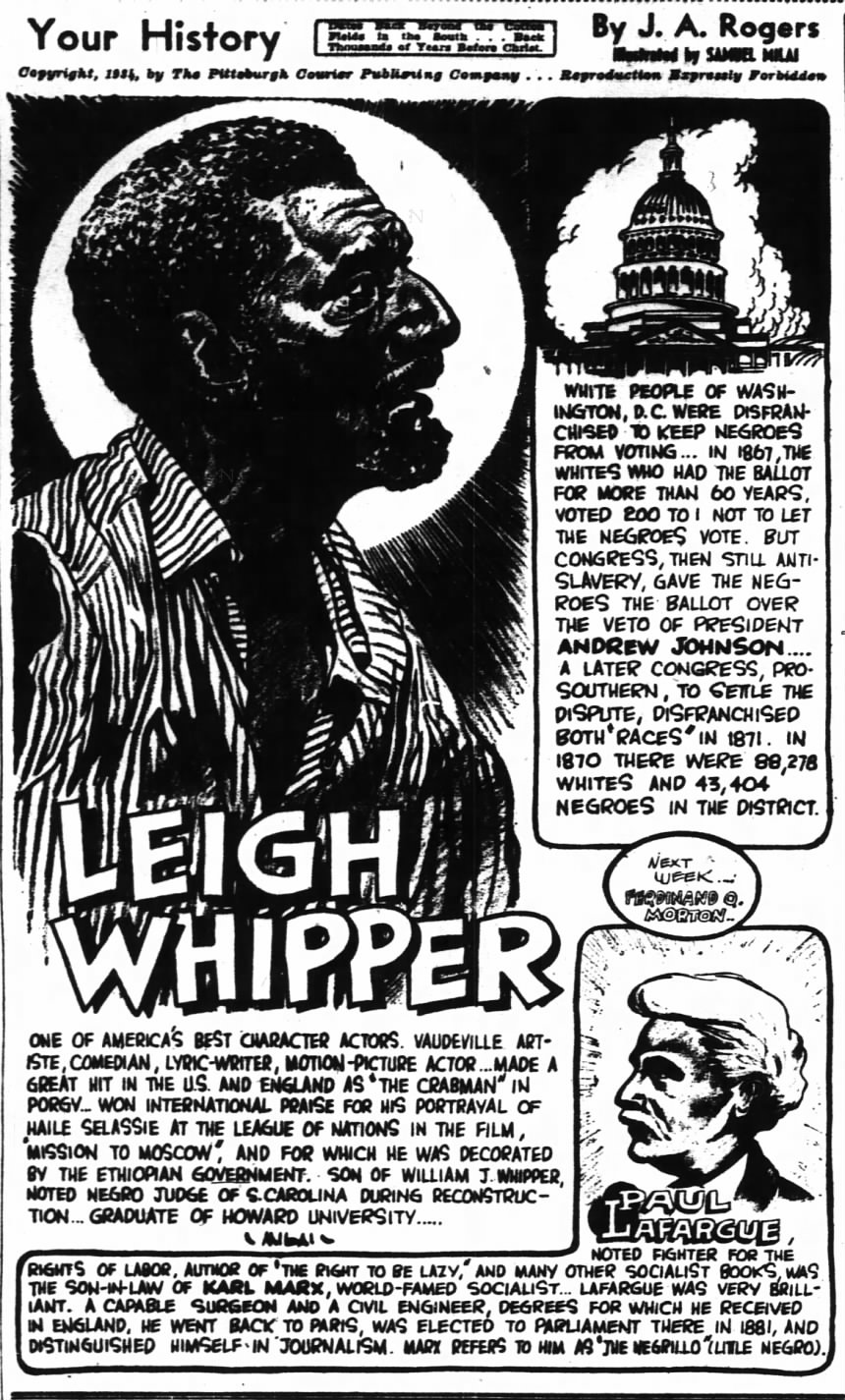
Article from 01 June 1946 New Pittsburgh Courier(Pittsburgh, PA)
NO COPYRIGHT INFRINGEMENT INTENDED
Iforcolor.org 2026 – All rights reserved ©2026