“Leigh Whipper, the first Black member of the Actors’ Equity Association (1913), was born in Charleston, South Carolina in 1876. His father, William J. Whipper, was a Pennsylvania entrepreneur and abolitionist before the Civil War and later a member of two Constitutional Conventions during the Reconstruction era. His mother, Frances Rollin Whipper, was a writer. Whipper attended public school in Washington, D.C. After leaving Howard University Law School in 1895, he immediately joined the theater.

Photograph of Leigh Whipper © Estate of Leigh Rollin Whipper, Courtesy of Carole Ione Lewis
- The 1868 Constitution: He was a primary architect of one of the most progressive state constitutions in U.S. history, which established universal male suffrage and public education.
- Judge Whipper: Despite immense racial hostility, he was elected as a judge in Charleston. White lawyers often refused to practice in his courtroom, yet he remained a steadfast symbol of Black legal authority until the end of Reconstruction.
- Women’s Rights: Uniquely for his time, he was a staunch advocate for women’s right to vote, a trait he passed down to his children.
Frances Anne Rollin
A pivotal figure of the Reconstruction era, leaving behind a legacy that bridges the gap between early Civil War activism and the suffrage movement.
Her diary, kept primarily during 1868, is recognized as the earliest known diary by a Southern Black woman.
- Literary & Social Insight: It provides a rare, intimate look at the social and intellectual life of a politically engaged Black woman.
- Political Record: Beyond personal reflections, it documented the anti-Black and anti-Republican violence occurring in South Carolina during Reconstruction.
- Preservation: The physical diary is now part of the collection at the Smithsonian National Museum of African American History and Culture.
Rollin holds the distinction of writing the first full-length biography by an African American.
- The Subject: She was commissioned by Major Martin R. Delany, the highest-ranking Black officer in the Union Army, to write his life story.
- Pen Name: To avoid gender prejudice from publishers and readers, she published the book, Life and Public Services of Martin R. Delany, in 1868 under the name “Frank A. Rollin”.
- Legal Pioneer: In 1867, she won one of the earliest civil rights lawsuits after being denied first-class passage on a Charleston steamship.
- The Rollin Salon: Alongside her sisters, she hosted a political salon in Columbia that became an interracial hub for discussing civil and social rights.
- Advocacy: She was a fierce advocate for universal suffrage, famously asserting that voting was a human right, not a favor.
Never a drama student
Whipper honed his acting abilities by observing the techniques of some of the most established actors of his day and interpreting the voices of some of his favorite writers, including Paul Laurence Dunbar. By the turn of the century, he had made his first Broadway appearance in Georgia Minstrels.
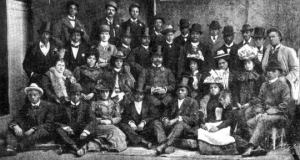
The GEORGIA MINSTRELS
From Wikipedia, the free encyclopedia
“Brooker and Clayton’s Georgia Minstrels was the first successful African American blackface minstrel troupe. The company was formed in 1865. Under the management of Charles Hicks, the company enjoyed success on tour through the Northeastern United States in 1865 and 1866. They billed themselves as “The Only Simon Pure Negro Troupe in the World” and their acts as an “authentic” portrayal of Black plantation life. One ad claimed their troupe was “composed of men who during the war were SLAVES IN MACON, Georgia, who, having spent their former lives in Bondage… will introduce to their patrons’ PLANTATION LIFE in all its phases.” For their part, the public and press largely believed them. One New York newspaper called them “great delineators of darky life” and said that they presented “peculiar music and characteristics of plantation life.”
The Georgia Minstrels gained fame and success, and large crowds watched them perform in many cities. They repeatedly outperformed both Black and White rivals throughout 1866. Trade journals and theatergoers came to regard them as in the same category as successful all-white companies, and “Georgia” came to signify “Colored” when used in the title of a minstrel troupe. Perhaps most significantly, the success of the Georgia Minstrels spawned many imitators. Other black troupes found greater success and acceptance, and black minstrelsy took off as a genre in its own right.”
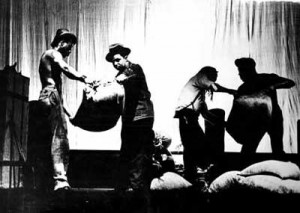
STEVEDORE – The play so resonated with Seattle’s audiences, who had experienced the 1934 longshore strike, that some members of the audience spontaneously joined the cast on stage to help build the barricades in the final scene. (Courtesy University of Washington Libraries, Special Collection Division, UW Theatres Photograph Collection, (PH Collection #236), box 4, folder 18.)K
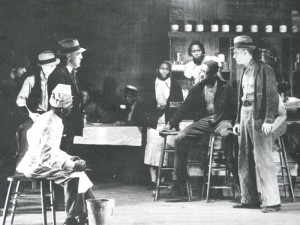
Stevedore‘s cast brought white and African American actors together in a play about the tenuous solidarity built during labor strikes. (Courtesy University of Washington Libraries, Special Collection Division, UW Theatres Photograph Collection, (PH Collection #236), box 4, folder 18.)
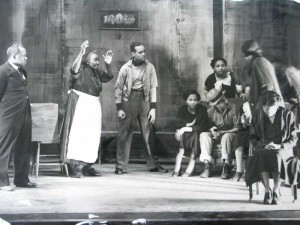
A scene from Stevedore. (Courtesy University of Washington Libraries, Special Collection Division, UW Theatres Photograph Collection, (PH Collection #236), box 4, folder 18.)