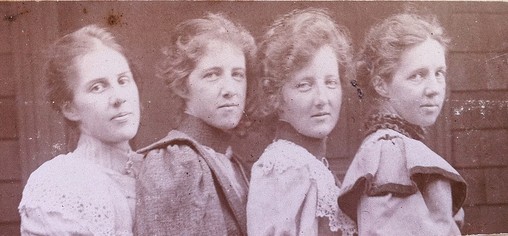
The Whitman Sisters were four African-American sisters who were stars of Black Vaudeville. They ran their own performing touring company for over forty years from 1900 to 1943, becoming the longest-running and best-paid act on the T.O.B.A. circuit. They comprised Mabel, Essie, Alberta “Bert” and Alice. – [Wikipedia]
The Whitman Sisters
“The Whitman Sisters were the highest-paid act on the Negro Vaudeville Circuit, Theater Owner Booking Association (Toby), and one of the longest surviving touring companies (1899-1942). From 1900 to 1943, they managed and starred in their own touring company, which served as a major incubator for future stars like Count Basie, Bill “Bojangles” Robinson, and Moms Mabley.
- Mabel (May) Whitman (1880–1942): The director and business manager who handled all bookings. Known as the “Tiger Show Woman,” she was a formidable entrepreneur who once forced a theater to desegregate its seating by refusing to perform otherwise.
- Essie Barbara Whitman (1882–1963): A deep-voiced contralto singer and comedian who also designed and executed the troupe’s elaborate costumes. After retiring in 1926, she became a lay preacher.
- Alberta “Bert” Whitman (1887–1964): A talented composer and “flash dancer” who excelled as a male impersonator, often performing in top hat and tails.
- Alice Whitman (1900–1968): Billed as the “Queen of Taps,” she was considered the greatest female tap dancer of the 1920s. Her son, Albert “Pops” Whitman, also became a renowned acrobatic tap dancer.
- Social Subversion: As light-skinned Black women, the sisters frequently challenged racial and gender norms. They used their appearance to “pass” or perform in blackface before revealing their true identity to audiences, subverting fixed ideas of race.
- Professionalism: Mabel ran the company with strict discipline, ensuring all performers were well-trained, well-clothed, and attended church every Sunday.
- Induction: In 2012, the sisters were posthumously inducted into the American Tap Dance Hall of Fame.
The group was considered the greatest incubator of dancing talent for Negro shows on or off Toby, and significantly contributed to American theater and dance history. In The Royalty of Negro Vaudeville, Nadine George-Graves provides a historical narrative of their achievements and uses Black feminist theories, feminist theories of performance, and theories of class and popular culture to analyze the many layers of performance in which the Whitman Sisters participated, both on and off the stage. She shows that these four Black women manipulated their race, gender, and class to resist hegemonic forces while achieving success. By maintaining a high-class image, they were able to challenge the fictions of racial and gender identity.”
“So completely has evidence of the Whitman Sisters disappeared that it’s almost as if someone had deliberately cut them out of the pages of show business history. Yet for forty years from the late 1890s to the late 1930s, the Whitman Sisters shows were the biggest, fastest, flashiest shows in black vaudeville. Their annual touring show became an incubator for talent—especially dancers. The kids who started in their shows or joined them later became some of America’s favorite comics, dancers, and musicians a few years later: Eddie “Rochester” Anderson, Count Basie, Trixie Smith, Moms Mabley, Jeni LeGon, Reed & Bryant. Pine Top Smith, Lonnie Johnson, and Mary Lou Williams.”
“There were four Williams Sisters: Mabel/May who ran the company and directed the show, Essie who was a big-voiced comic singer, and Alberta/Bert who was a flash dancer who worked in male drag. Alice, much younger than her sisters, was regarded by many as the greatest woman tap dancer of her day.
They were fearless, talented, and had a great sense of business. May ran the company like a strict schoolmaster and the kids in their care were trained and worked hard, fed and clothed well, sent to church on Sundays, and were prevented from engaging in any hanky-panky.
Despite their achievements of fielding shows year after year, of making news by integrating an audience as early as 1904, of being billed as the “Royalty of Negro Vaudeville,” of retiring wealthy to Chicago, the four Whitman Sisters are forgotten and only a few photos seem to exist.”
Stage Name – Whitman Sisters: considered the royalty of Black vaudeville entertainment from 1900 to 1943. Introduced the cakewalk in 1908.”
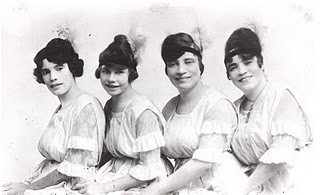
“The sisters grew up in a religious home with their father as a minister and sang Jubilees at church. When they were young they arranged shows for their church which gave them experience when it came to producing later on in life. They would tour at a young age, singing and dancing in various church functions and vaudeville shows with their mother in tow as chaperones. They finally started their own act, The Whitman Sisters New Orleans Troubadours around 1903, which consisted of Alberta, Mabel, and Essie; Alice would join them after their mother died in 1909.”
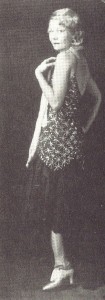
Alice Whitman
(Source: Nadine George-Graves, 2000
Alice Whitman
(Source: Nadine George-Graves, 2000)
NEGOTIATING GENDER AND RACE
“The social role remodeling went even further. Tough they capitalized also on the erotic elements in their performances, by their way of dancing and dressing which highlighted their female elegance and beauty, at the same time the sisters acted in such a way that their dancing was never labeled as “loose”, or could be stigmatized as obscene or morally corrupt. The audience’s attention was constantly focused on the skills of the performers, rather than on the physical presentation. Alice, the “adorable baby”, was one of the only American soloist female tap dancers, hence challenging the contemporaneous gender roles in dancing, but it did not prevent her from being called the “Queen of the taps.” She was an adorable girl, and combined her attractiveness with utterly strong dancing techniques. Until succeeded by her son, Albert, “Little Pops”, she was the troupe’s star performer. The recognition of her mastery of the tap dancing in an era where it was expected that women soloists in show business were in the first place singers, in order not to jeopardize their reputation, strengthened the message Alice sent out to do away with the ruling role models.
In her ravishing femininity, Alice often danced graceful duets with a character called Bert, a fancy dressed, dapper, neatly dressed “man-about-town”. Bert was nobody else than Alberta Whitman, cross-dressed, who was known as the best male impersonator of her time. Here, also, gender roles were challenged, in a way however that stood miles from the classical nineteenth-century travesty dancing which was often no more than an excuse to “get women into short pants to show off their legs and reinforce dominant sexual norms.” (George-Graves, 2000:77). Alberta Whitman made an art of astonishingly and convincingly changing characters in the course of no more than twenty minutes, reproducing authentic “male style, fashion, and stance” (id.). Her performance was well received by critics and audiences, and her gender transgression art was an integral part of the top quality show the sisters constantly endeavored to bring. Cross-dressing, a standard line in the show business, was taken at a higher level to fit into the high class entertainment envisioned by Mabel, Essie, Alberta and Alice.
Combining high quality entertainment in theaters and churches, offering variety acts which spoke to both sexes, the Whitman Sisters remained popular for all social classes, both black and white. Much more delicate than the refiguring of class and gender in a period of blatant segregation was however the Sisters’ manipulation of race roles, of undermining the notion of a fixed racial identity. Let us indeed not forget that racial identity was a corner stone of American society and hence also an inescapable element in theater and entertainment. Jumping out of the racial categorization could entail total marginalization, at the least, and physical aggression as an unexceptional reaction.
Nevertheless, the Whitman Sisters displayed on stage the whole gamut of roles from the “darkest dark to the palest of pale”. It was a rainbow of beautiful girls, as George-Graves formulated it so poetically (71). They performed as Black acts, sometimes blackening-up their faces (using burnt cork or greasepaint), and occasionally – especially in their initial career – appeared as a White act. They masterfully slipped in and out racial stereotypes, passing for both Black and White. This way they totally controlled the interpretation of their roles not only related to gender but also to race.
As noted already, the Whitman Sisters sometimes performed in Black-haired wigs and blackface, and then, during the finale, took off the makeup and wigs to let their dyed blond hair down when they came back on stage. It left the audience completely puzzled with regard to the racial identity of the performers. The Black women were mistaken for White women, who blackened up to remove the dark masker and to appear as black women. An amazed laughter by the public probably concealed complete disorientation with regard to the real racial identity of the women. What was certain? Were they Black or White? Were the White women Black, or were the Black women White? Were they white women with blond hair, or Black women with Black hair? Total disorientation must have been the public’s fate.”
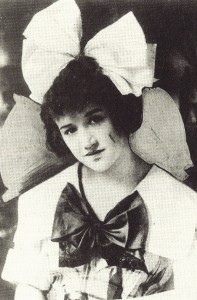
Alice Whitman
(Source: Nadine George-Graves, 2000
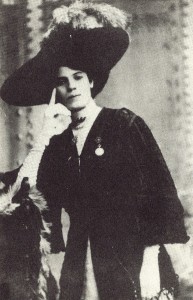
Alberta Whitman
(source: Nadine George-Graves, 2000)