House of Reformation and Instruction for Colored Children

by DALE RICARDO SHIEDS

– The House of Reformation and Instruction for Colored Children, established in 1870 in Cheltenham, Maryland, was the first juvenile reformatory for Black boys in the American South.

Originally intended to remove Black youth from adult prisons, it became a site of systemic abuse, forced labor, and severe neglect for decades. 
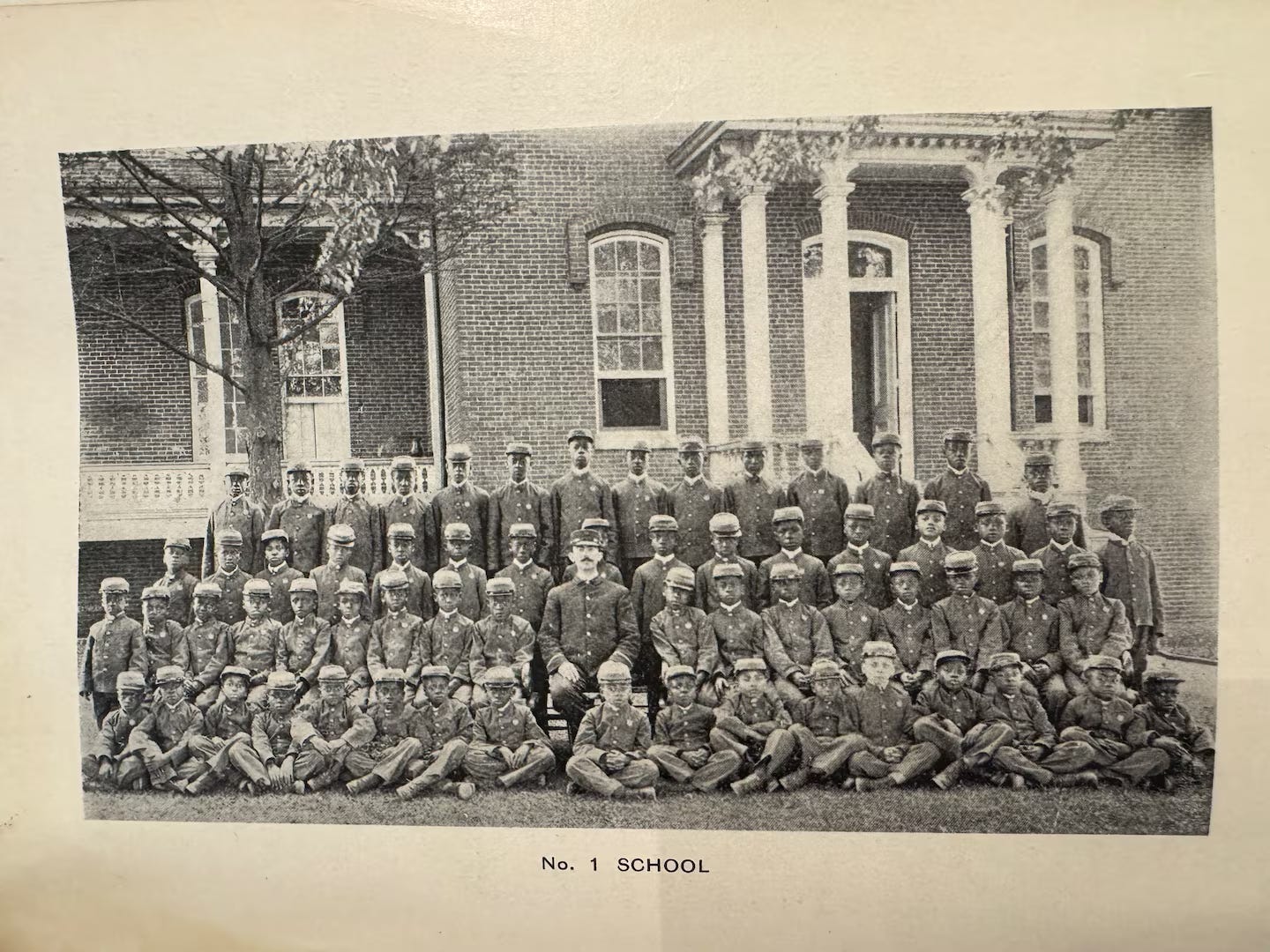
Operated for decades under a system of forced labor, severe physical abuse, and neglect before the state took full control in 1937.

.

Established on 752 acres of a former plantation donated by businessman Enoch Pratt.Purpose: 

.

Created to remove Black children from adult prisons, though it functioned primarily as a source of cheap labor through convict leasing.  Children as young as five were sent there for offenses ranging from theft to “vagrancy” or being “incorrigible”.

.

Boys worked six days a week in fields, workshops, or were “paroled to service” for private families until age 21.Discipline: Children endured beatings with three-ply leather whips, rubber hoses, and wooden clubs.

.

Reports from the 1920s and 30s described the facility as a “hell hole” with overcrowded, unsanitary conditions and “disease-breeding” environments. Many succumbed to tuberculosis (consumption), pneumonia, heart failure, and exhaustion.

.

Lack of Notification: Families were rarely notified of deaths; in some cases, staff falsely claimed missing boys had simply run away. An estimated 230 to 300 boys are buried in two wooded sections near the facility, often marked only by cinder blocks. 


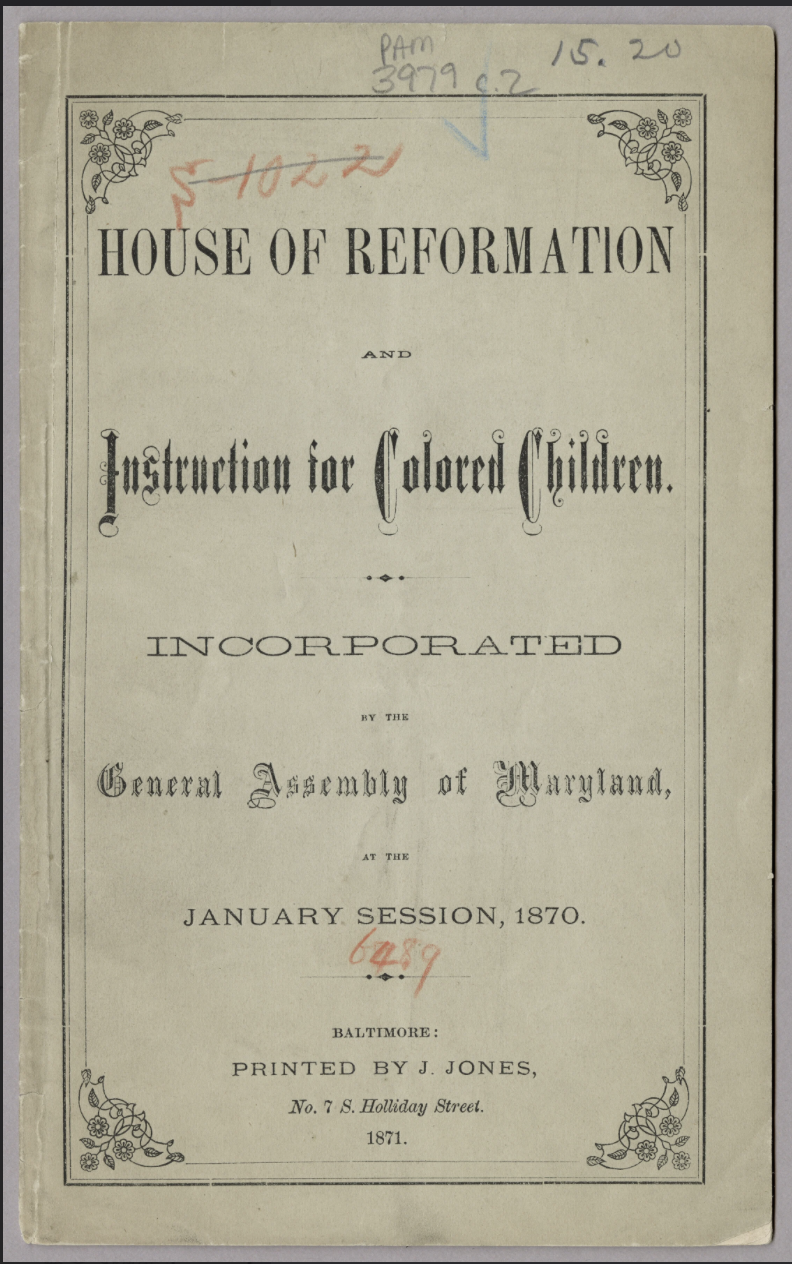
Pamphlet containing a copy of “An Act to Incorporate a House of Reformation and Instruction for Colored Children” presented at the January Session, 1870, of the General Assembly of Maryland. Also includes excerpts from reports in favor of the establishment of such an institution from the Grand Jury and the Warden of the Penitentiary and Board of Visitors to Baltimore City Jail.

An appeal to the public for funds to establish a reform school for African-American boys in Maryland in the wake of emancipation, conceived as an alternative to the deplorable and corrupting circumstances of prison, with a view to creating a better educated and more productive labor force.

As observed in the opening address to the public, at the time of publication Maryland had a reform school for white boys, known as the “House of Refuge,” but no similar institution for African-American boys. The Legislature had recently passed an act of incorporation for such a school, but funds were lacking. It is noted that a visit to the Penitentiary reveals that “four hundred and fifteen colored persons are incarcerated therein, and of this number eleven are children under twelve years of age, and one of them but five years old, so small as to be able to creep through the prison bars.”

A recent “Visitors to the Jail” report noted that in 1870 some 2,335 Black youths had passed through the prison doors, having been apprehended “for violation of the Peace and for Drunkenness,” “Larceny,” “Vagrancy,” etc.

These crimes included such trivial offenses as stealing three loaves of bread, stealing 23 cts., etc., and many of the prisoners were children between the ages of five and sixteen. Maryland being dependent upon the large black population for labor, much of which had formerly been enslaved, the argument is made here “that a better use should be made of them than supporting them in our prisons.”

In addition to the four-page “Address to the Public,” the pamphlet includes a list of the school’s officers and the Act of Incorporation.

“We need to be mindful of never, ever allowing something like this to happen again,”
At least 230 Black boys and young men died while in custody at the House of Reformation and Instruction for Colored Children in Cheltenham, Maryland.
The facility, which opened in 1873 as a segregated alternative to adult prison for Black youth, operated for decades under conditions that included forced labor, severe physical abuse, and neglect, with many victims buried in unmarked, abandoned graves on the grounds.

Maryland probes racist incarceration of children
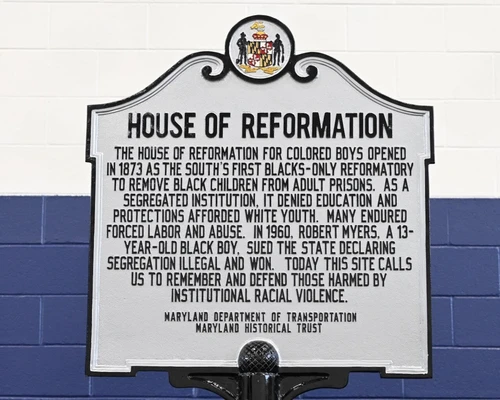
 

House of Reformation marker unveiled Wednesday at the Cheltenham Youth Detention Center in Prince George’s County. The marker will be placed nearby at the corner of Frank Tippett and Surratts roads. (Photo by William J. Ford/Maryland Matters)

About the House of Reformation Deaths

  • Location: The facility was located in Prince George’s County, Maryland. The burial site is in a wooded area bordering the now-manicured Cheltenham Veterans Cemetery.
  • Timeframe: The 230+ deaths occurred between 1870 and 1939, with many boys as young as 10 years old being sent to the facility for minor offenses such as “vagrancy,” “incorrigibility,” or being orphans.
  • Causes of Death: Common causes identified in records included tuberculosis, pneumonia, exhaustion, and physical abuse.
  • Unmarked Graves: Many children were buried without proper coffins or headstones, often marked only by simple concrete cinder blocks, which became overgrown with vegetation over the decades.
  • Forced Labor: Inmates were often leased out to local farmers for labor, subjected to brutal physical punishments including whipping with leather whips and rubber hoses.

Maryland leaders look to preserve history of Black boys who died at former reform school.

Recent Investigations and Memorialization (2025–2026)

  • Discovery: The forgotten cemetery was identified through the “Forgotten Children Initiative,” a research project focused on uncovering lost burial grounds of incarcerated children.
  • Historical Marker: On May 6, 2026, Governor Wes Moore unveiled a historical roadside marker at the site to honor the victims and acknowledge the state’s role in the abuse, stating, “Loving our state does not mean lying about its history”.
  • State Action: The state of Maryland has allocated funding for further investigation, including archaeological surveys to map the graves and potential forensic analysis to identify the boys.
  • Ongoing Probe: Lawmakers, including the Legislative Black Caucus of Maryland, are working to restore the burial site and ensure the stories of these children are permanently acknowledged. ‘


This is where they came to die


🏛️ Institutional History

  • Founding: Incorporated by the Maryland General Assembly in 1870 after Baltimore businessman Enoch Pratt donated 752 acres for the site.
  • Purpose: While ostensibly for “discipline and instruction,” it functioned as a pipeline for forced labor, where boys as young as five were leased to local farms.
  • Evolution: The facility underwent several name changes, becoming the Cheltenham School for Boys(1937), Boy’s Village of Maryland (1949), and finally the Cheltenham Youth Detention Center (1992), which remains operational today.
  • Desegregation: The institution remained strictly segregated until 1961, following a landmark court case supported by Thurgood Marshall.  


Enoch Pratt donated 700 acres in Prince Georges County to found the House
of Reformation and Instruction for Colored Children (Cheltenham).  Before
this time African-American boys, some as young as eight years old, who
committed crimes were routinely confined in jails and the state penitentiary. A former plantation in southern Prince George’s County, to be used for the school.  Pratt served as president of the school’s board for a number of years, and was also instrumental to the establishment of Baltimore’s public library system, believing “a free circulating public library open to all citizens regardless of property or color” to be the city’s greatest need.


This image from the Sept. 8, 1934 Afro-American describes conditions at Cheltenham. Image: Afro-American


An abandoned graveyard in Maryland is finally being restored to honor the 230 Black boys buried there, who died while confined to the House of Reformation and Instruction for Colored Children.⁠

The House of Reformation and Instruction for Colored Children was a state-run juvenile detention facility located in Prince George’s County that operated from the late 19th to early 20th century. ⁠

According to a Washington Post investigation, many Black children were sent to the House of Reformation for minor offenses, subjected to forced labor, and endured harsh conditions before dying in custody. ⁠

The Maryland cemetery containing the remains of boys who died between 1870 and 1939 was rediscovered last year by the state Department of Juvenile Services.⁠

Governor Wes Moore’s administration has pledged $250,000 in the next budget to begin the restoration, which includes uncovering more unmarked graves, repairing headstones, and creating a memorial.⁠

“We need to be mindful of never, ever allowing something like this to happen again,” State Senator Michael Jackson said.⁠”

Lost Shoes: the Forgotten Children Initiative


Governor Wes Moore

Loving our state does not mean lying about its history. It means telling the truth — even when the truth is hard.”


“Today we honored the more than 230 Black boys who died at the House of Reformation and lie in unmarked graves. And today, we announced that we are restoring their burial sites.”

“Their stories deserve justice and their souls deserve eternal peace.

Westley Watende Omari Moore is the 63rd Governor of Maryland, sworn in on January 18, 2023.  – He is Maryland’s first Black governor and only the third African American elected as a governor in U.S. history.

“Today is an important reminder that darkness does not win, light does.”

“Here they were whipped and beaten — their humanity taken away from them,”

 “Boys died of disease and exhaustion here.”


Governor Moore unveiled a roadside marker to officially acknowledge the institutional racial violence and deaths at the site.

State Investigation: Maryland has allocated over $1 million for a commission to conduct forensic analysis and genealogical research to identify the buried children.

Restoration: Efforts are underway to clean up the burial site and restore dignity to the grounds, which sit just yards away from the well-maintained Cheltenham State Veterans Cemetery.

Gov. Wes Moore (D), center, looks at roadside historical marker unveiled Wednesday that pays homage to Black youth buried on property at the former House of Reformation and Instruction for Colored Children in Prince George’s County.  (Photo by William J. Ford/Maryland Matters)

Maryland Governor Wes Moore unveils House of Reformation marker

The state’s newest historical marker recognizes a difficult and often overlooked moment in Maryland’s past,” said Maryland Department of Transportation Secretary Katie Thomson. “The Maryland Department of Transportation, in partnership with the Maryland Historical Trust, encourages the traveling public to reflect and honor the boys from the House of Reformation.”
“Now begins the important work of not just uplifting the voices of the young boys who received unequal treatment at this site, but ensuring our agency today is treating the children we serve with the humanity they deserve, so that they may have the space to be held accountable and to learn the skills that help them navigate the difficult situations that lead to crisis and crime,” said Maryland Department of Juvenile Services Secretary Betsy Fox Tolentino.

In his remarks, the governor highlighted the landmark 1961 legal victory in State Board of Public Welfare v. Myers, a case litigated by pioneering attorney Juanita Jackson Mitchell and supported by Thurgood Marshall. The lawsuit, filed on behalf of 13-year-old Robert Myers, successfully applied the principles of Brown v. Board of Education to juvenile facilities, ending de jure segregation in Maryland’s reform schools. The legacies of Robert Myers and Juanita Jackson Mitchell are central to the the Department of Juvenile Services’ “Roots to Rise” initiative, which anchors the state’s youth justice work in historical truth-telling and community partnership to build a justice system focused on empowerment and restoration.
Following the unveiling ceremony, Governor Moore led a sacred acknowledgment at the site of the future archaeological project. The solemn gathering included prayer to honor the children buried on the grounds and offer blessings for the restorative work ahead.”


Juanita Jackson Mitchell (1913-1992) was the first Black woman to practice law in the state of Maryland.

Scottsboro Boys and Juanita Jackson Mitchell

Juanita Jackson Mitchell was the pioneering attorney who represented Robert Myers in the landmark 1961 case State Board of Public Welfare v. Myers, which successfully ended segregation in Maryland’s juvenile facilities.

Key Details of the PartnershipThe Attorney: Juanita Jackson Mitchell was a legendary civil rights figure.

The Client: Robert Myers was a 13-year-old boy detained at the Cheltenham School for Boys (then known as the House of Reformation), a segregated reform school.

The Case: Mitchell and co-counsel Tucker Dearing sued the state, arguing that segregated juvenile housing was unconstitutional.

Their victory forced the desegregation of Maryland’s youth detention centers, marking a major milestone in the state’s civil rights history.

Recent news highlights Robert Myers, who was 13 years old when he became the lead plaintiff in a landmark 1961 legal case, State Board of Public Welfare v. Myers.

This lawsuit ended racial segregation in Maryland’s juvenile facilities, applying the principles of Brown v. Board of Education to reform schools. – Historical Significance of Robert Myers Civil Rights Case: In 1960,

Robert Myers sued the state of Maryland while being held at a segregated reform school then known as Boys Village (now Cheltenham).

The legal victory in 1961 successfully integrated these facilities.Legal Support: His case was litigated by Juanita Jackson Mitchell, and was supported by Thurgood Marshall. 


Thurgood Marshall

Thurgood Marshall was a pioneering civil rights attorney who became the first African American justice to serve on the U.S. Supreme Court. Before his appointment to the bench, he was the chief architect of the legal strategy that dismantled state-sponsored segregation in the United States. He is most famous for arguing and winning the landmark case Brown v. Board of Education (1954), which declared racial segregation in public schools unconstitutional.

Recent Commemoration:  On May 7, 2026, Governor Moore of Maryland unveiled a roadside historical marker at the former House of Reformation for Colored Boys to recognize this history and the legacy of Robert Myers.

Personal Legacy: His sister, Janice Griffin, recently attended the ceremony honoring him, noting that her brother did not have a decent life and that his time at the reformatory was difficult.


LINKS:


The Scene at Cheltenham, Md., Burial Site:

In the woods of southern Prince George’s County are the mostly unmarked graves of youths who died while at the notorious House of Reformation and Instruction for Colored Children.


Black Maryland legislators visit historic graveyard where over 200 youth are buried.

https://www.nbcwashington.com/video/news/local/prince-georges-county/black-maryland-legislators-visit-historic-graveyard-where-over-200-youth-are-buried/3992540/

https://www.washingtonpost.com/video/local/the-lost-graves-of-cheltenham/2025/07/17/affe1d35-3fd3-441c-8270-34994f637d0d_video.html 


The Burial Site: The graves are located in a wooded area bordering the current Cheltenham Youth Detention Center and the manicured Cheltenham Veterans Cemetery.Investigation: The state of Maryland has pledged to investigate the deaths, with the Attorney General’s office leading an effort to map the graves and identify the victims.


https://governor.maryland.gov/news/governor-moore-unveils-roadside-historical-marker

https://msa.maryland.gov/msa/refserv/bulldog/bull01/bull15-19/html/bull15-

.htmlhttps://wtop.com/prince-georges-county/2026/05/md-honors-kids-sent-to-die-at-cheltenham-and-then-forgotten/

https://www.jamesarsenault.com/pages/books/6218/house-of-reformation-and-instruction-for-colored-children-incorporated-by-the-general-assembly?soldItem=true

https://www.blackwomendaily.com/featured/juanita-jackson-mitchell

https://www.aol.com/news/survivors-stories-st-josephs-orphanage-084649925.html

https://southernmarylandchronicle.com/2026/05/07/this-is-where-they-came-to-die-historical-marker-highlights-horrors-at-segregated-reform-school/

https://marylandmatters.org/2026/05/07/this-is-where-they-came-to-die-historical-marker-highlights-horrors-at-segregated-reform-school/

https://governor.maryland.gov/news/governor-moore-unveils-roadside-historical-marker

Victoria Lavelle/AFP via Getty Images


EDUCATIONAL/Research – No copyright infringement intended.

© Dale Ricardo Shields (2026)