Lorraine Vivian Hansberry
Playwright, Activist, and Author
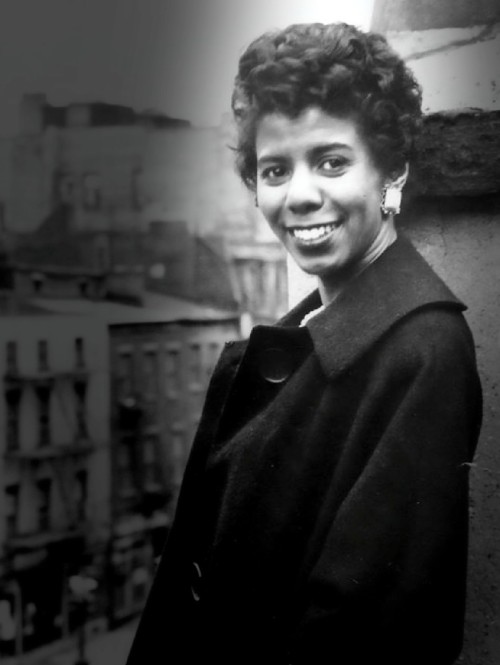
Lorraine Hansberry was the youngest American playwright ever to win the Best American Play Award from the New York Drama Critics’ Circle for A Raisin in the Sun. Her other works include The Sign in Sidney Brustein’s Window and Les Blancs. By Dale Ricardo Shields(c) All Rights Reserved – iforcolor.orgBrilliant and Radical!
By Dale Ricardo Shields
(c) All Rights Reserved – iforcolor.org
“Write if you will: but write about the world as it is and as you think it ought to be and must be—if there is to be a world. Write about all the things that men have written about since the beginning of writing and talking—but write to a point. Work hard at it, care about it. Write about our people: tell their story. You have something glorious to draw on begging for attention. Don’t pass it up. Don’t pass it up. Use it. Good luck to you. The Nation needs your gifts.”
― from “To Be Young, Gifted, and Black” (1964) – TO BE YOUNG, GIFTED AND BLACK: An Informal Autobiography (1969) by Lorraine Hansberry
Legacy
- Early Inspiration: Born in Chicago, her family’s real-life fight against racially restrictive housing covenants led to the U.S. Supreme Court case Hansberry v. Lee, which served as the inspiration for her most famous work.
- Activism and Journalism: She moved to New York in 1950 and worked for Paul Robeson‘s Pan-Africanist newspaper, Freedom, where she collaborated with intellectuals like W.E.B. Du Bois.
- Personal Life: Hansberry lived a “parallel life” as a closeted lesbian, contributing to the homophile magazine The Ladder and advocating for gay rights under pseudonyms. She was married to Robert Nemiroff from 1953 until their divorce in 1962, though they remained close collaborators until her death.
- Death and Honors: Her career was tragically cut short when she died of pancreatic cancer at age 34. Posthumously, she inspired Nina Simone’s anthem “To Be Young, Gifted and Black” and was inducted into the National Women’s Hall of Fame.
- A Raisin in the Sun (1959): A realistic depiction of Black working-class life in Chicago.
- The Sign in Sidney Brustein’s Window (1964): Her second play, which explores themes of political commitment and idealism in Greenwich Village.
- To Be Young, Gifted and Black (1969): A posthumous collection of her writings adapted into a play and book.
- Les Blancs (1970): A play examining African liberation and colonialism, completed posthumously by Robert Nemiroff.
~*****~
“As long as the world has a problem with the fact that I am Black, I will make a point of honor to be one.”
~*****~
“Never be afraid to sit awhile and think.”
~*****~
“I would very much like to live in a world where some of the monumental problems could at least be solved; I’m thinking, of course, of peace. That is, we don’t fight. Nobody fights. We get rid of all the little bombs and the big bombs.”
Biographical Timeline
May 19, 1930 — Lorraine Vivian Hansberry is born to Carl Augustus Hansberry, Sr. and Nannie Louise Hansberry in Chicago, Illinois.
1937 — Carl moves his family to a home in the Woodlawn neighborhood’s all-White Washington Park subdivision in defiance of a restrictive covenant. Local backlash against the Hansberry family eventually results in a legal case.
1940 — Carl runs unsuccessfully for Congress as a Republican. Later, the U.S. Supreme Court rules in favor of Carl in the case of Hansberry v. Lee. Although the decision enables the Hansberry family to remain in their home in Woodlawn and opens new homes to African-Americans in Chicago, restrictive covenants remain legal.
May 1941 — A decision is rendered in the case of Carl Hansberry Sr. v. Atchinson Topeka, Santa Fe Railway, Pullman Company. Carl Hansberry Sr. sued for discrimination during a train trip for which he paid for a first class ticket. The case was thrown out due to lack of jurisdiction.
1944 — Perry Hansberry v. Franklin Delano Roosevelt: Perry Hansberry is drafted into the US military and sues the US Government, requesting that his draft order be rejected on the grounds that the army is segregated. Perry Hansberry bases this argument on the experience of his brother, Carl Hansberry, Jr., who already in the military. The case is thrown out due to lack of jurisdiction.
1946 — Carl dies suddenly in Mexico of a cerebral hemorrhage while planning to move his family there.
1948 — Lorraine enrolls at the University of Wisconsin. While there, she attends a performance of Sean O’Casey’s Juno and the Paycock, which inspires her to become involved in theater.
Lorraine participates in the presidential campaign of Henry Wallace, who runs as a Progressive Party candidate. Later in 1948, she joins the Communist Party. Nationally, restrictive covenants are abolished with the Shelley v. Kraemer decision, and President Harry Truman ends racial segregation in the U.S. military with Executive Order 9981.
1950 — Lorraine leaves the University of Wisconsin to pursue “an education of another kind” and moves to New York City. Her poem “Flag from a Kitchenette Window” is published in Masses & Mainstream, an American Marxist monthly. In November, Paul Robeson founds Freedom newspaper in Harlem, publishing an “introductory issue” with the editor Louis Burnham. Lorraine works for the paper as a subscription clerk, receptionist, typist and editorial assistant.
1951 to 1960 — Carl Hansberry, Jr. and the Hansberry family face lawsuits for building code violations in several of their apartment buildings.
1951 — First issue of Freedom is published. Lorraine travels to Mississippi with a delegation of women to petition the Governor for a stay of execution for Willie McGee. On May 8, McGee is executed after protests on his behalf and several stays of execution. In July, Lorraine’s poem about Willie McGee’s execution, “Lynchsong,” is published in Masses & Mainstream. In the fall, Lorraine joins The Sojourners for Truth, a delegation of 132 Black women seeking an end to war and racial discrimination, in Washington, D.C.
1952 — Lorraine becomes associate editor of Freedom. In March, she travels to Montevideo, Uruguay, to speak on behalf of Paul Robeson at the Intercontinental Peace Conference. Her passport is revoked upon her return to the U.S., and the FBI begins lifelong surveillance of her. In July, Lorraine meets Robert Nemiroff. In December, she resigns from full time work at Freedom to focus on creative writing.
1953 — Lorraine and Robert join protesters against the execution of Ethel and Julius Rosenberg, convicted for treason for selling nuclear secrets to the Soviet Union. In June, Lorraine marries Robert in her mother’s home in Chicago.
1955 — Freedom newspaper ends publication.
1956 — Lorraine is able to quit her part-time work and focus on writing after the songwriting success of her husband and his college friend Burt D’Lugoff. “Cindy, Oh Cindy,” written using pseudonyms, is released by Vince Martin and the Tarriers and Eddie Fisher
1957 — Lorraine and Robert secretly separate. In the fall, Lorraine holds a dinner party with Phil Rose and Burt D’Lugoff to read her first draft of the play that became A Raisin in the Sun. Phil Rose wants to produce it and options the play for $500. Rose gets his friend Sidney Poitier to sign on to star in Hansberry’s play, and Poitier, in turn, recommends Lloyd Richards as its director. Around the same time, the first issue of The Ladder, the first national publication for lesbians, is published by the Daughters of Bilitis.
1958 — Lorraine writes three short stories for ONE Magazine (“The Budget,” “The Anticipation of Eve,” and “Renascence”) and another short story called “Chanson du Konallis” for The Ladder under the pseudonym Emily Jones. In the fall, nearly 1,000 black actors show up for auditions for A Raisin in the Sun.
1959 — A Raisin in the Sun has its first public performance at the Shubert Theater in New Haven, Connecticut as part of a four-night tryout. A few weeks later, the play begins a two-week tryout run at the Walnut Theatre in Philadelphia, PA. Writer James Baldwin attends a performance, later writing about witnessing theater history. The FBI sends an agent to assess the play for Communist influences. In February, A Raisin in the Sun begins its final tryout, a four-week run at the Blackstone Theater in Chicago, Illinois. That same month, Sidney Poitier is nominated for an Academy Award for Best Actor for his role in The Defiant Ones.
In March, Lorraine gives the keynote speech titled “The Negro Writer and His Roots” at the American Society of African Culture (AMSAC) Negro Writers Conference at the Henry Hudson Hotel in New York. That same month, A Raisin in the Sun premieres on Broadway at the Ethel Barrymore Theater. In April, Lorraine wins the New York Drama Critics’ Circle Award for the play. That spring, Random House publishes A Raisin in the Sun.
In April, David Attie photographs Lorraine in her Bleecker Street apartment for Vogue. Lorraine and A Raisin in the Sun‘s Director, Lloyd Richards, are among the guests at a roundtable discussion on the state of Broadway on David Susskind’s Open End television show.
In May, Lorraine appears on the broadcast public affairs program Look Up and Live, sits for an interview with Mike Wallace, and is interviewed by Studs Terkel for his radio show in Chicago. She later gives a lecture about American drama at Roosevelt University in Chicago for the school’s Women’s Scholarship Association. Lorraine and film director Otto Preminger appear on At Random, Irv Kupcinet’s local weekly television conversation on Chicago’s WBBM. The conversation becomes heated as Hansberry describes Preminger’s film Porgy and Bess as “bad art” for its depiction of racial stereotypes.
In August, Lorraine completes her teleplay, The Drinking Gourd, for an NBC series commemorating the centennial of the Civil War. The series is cancelled before production begins due to lack of interest from funders. Lorraine completes the screenplay for A Raisin in the Sun. After 198 performances, Ossie Davis replaces Sidney Poitier as Walter Lee Younger in A Raisin in the Sun.
In October, A Raisin in the Sun moves to the Belasco Theater.
1960 — Lorraine uses money from the success of A Raisin in the Sun to purchase a home at 112 Waverly Place in Greenwich Village, where Burt D’Lugoff and Hansberry’s on-again-off-again partner Dorothy Secules live. In June, A Raisin in the Sun ends its Broadway run after 530 performances.
1961 — The film version of A Raisin in the Sun premieres at the Cannes Film Festival and wins the Gary Cooper Award for Human Values. Later that year, it is released by Columbia Pictures in the U.S. Lorraine and Lloyd discuss their work, and a scene of Hansberry’s work-in-progress, “Toussaint,” is performed on Playwright at Work, a television series hosted by Frank Perry.
1962 — Lorraine moves to Croton-on-Hudson, New York. In October, she speaks at an anti-HUAC rally, delivering her “My Government is Wrong” speech.
1963 — Lorraine has an attack and collapses in pain. She is subsequently hospitalized for 10 days, during which time doctors diagnose her with cancer. She is told she has anemia and bleeding ulcers. In May, a meeting between Attorney General Robert F. Kennedy and a handful of civil rights activists, entertainers and artists, including Lorraine Hansberry, to discuss racial tensions is held at the Kennedy’s Manhattan apartment.
In June, Lorraine Hansberry, Nina Simone and several other influential people attend a press conference at the home of actor and activist Theodore Bikel in order to publicize the upcoming Student Nonviolent Coordinating Committee (SNCC) benefit concert at Carnegie Hall. Lorraine chairs a fundraiser in Croton-on-Hudson to raise money for civil rights organizations’ work in the south. The event raises $5,000, some of which goes towards purchasing the Ford station wagon driven by Andrew Goodman, Michael Schwerner and James Chaney the following summer. That same month, Lorraine has an unsuccessful operation in New York.
In August, Lorraine undergoes surgery at the Lahey Clinic at the New England Baptist Hospital in Boston, Massachusetts.
1964 — The Movement: Documentary of a Struggle for Equality, a fundraising book for the Student Nonviolent Coordinating Committee (SNCC), comprised of photos with commentary by Lorraine Hansberry, is published by Simon & Schuster. Robert obtains a divorce from Lorraine Hansberry in Mexico. In May, Lorraine, released from the hospital for the afternoon, delivers what becomes known as the “To Be Young, Gifted, and Black” speech to winners of a writing contest sponsored by the United Negro College Fund.
In June, Lorraine leaves her sickbed to argue for militant commitment to black causes as a participant in “The Black Revolution and the White Backlash,” a Town Hall debate between black artists and white liberals. The event is sponsored by the Association of Artists for Freedom, of which Lorraine Hansberry is a member. Freedom Summer civil rights workers Andrew Goodman, James Chaney and Michael Schwerner go missing in Mississippi. The three are last seen in the Ford station wagon purchased with proceeds from Lorraine’s fundraiser. The Ford is later found, burned, in a swampy area near Philadelphia, Mississippi, and the bodies of the three men are later discovered in an earthen dam.
In the fall, Lorraine names Robert literary executor of her will, moves to the Hotel Victoria on Seventh Avenue to be near rehearsals of her second Broadway play, The Sign in Sidney Brustein’s Window. The play opens in October at the Longacre Theatre, co-produced by Robert Nemiroff and Burt D’Lugoff and directed by Peter Kass. Lorraine Hansberry attends opening night. While the play initially struggled at the box office, a celebrity campaign organized by Robert Nemiroff, Mel Brooks and wife Anne Bancroft makes the play the longest-running show of that season.
January 12, 1965 — Lorraine Hansberry dies of cancer of the duodenum at the age of 34 at University Hospital. The Sign in Sidney Brustein’s Window closes.
January 15, 1965 — Lorraine’s memorial service is held at the Church of the Master in Harlem. Over 600 people attend despite a huge blizzard, including Malcolm X, Ossie Davis, Diana Sands and Sammy Davis, Jr. Ruby Dee and Shelley Winters speak. Paul Robeson delivers the eulogy. Nina Simone performs. A telegram from Martin Luther King, Jr. is read. James Baldwin, although not able to attend, sends his condolences to Robert Nemiroff and the Hansberry family, saying, “I think we must resolve not to fail her, for she certainly did not fail us.” Lorraine is buried in Croton-on-Hudson at Bethel Cemetery.
1969 — To Be Young, Gifted and Black, a play about the life of Lorraine using her own words, compiled by Robert Nemiroff, is first performed off-Broadway at the Cherry Lane Theatre. Nina Simone performs her song “To Be Young, Gifted and Black” for the first time at a Morgan State College jazz festival. The song is inspired by Lorraine Hansberry’s words.
1970 – “Les Blancs,” an unfinished play by Lorraine about colonialism set in Africa and edited by Robert Nemiroff, opens at Broadway’s Longacre Theatre. It runs for one month and has 40 performances.
1976 — Lorraine is publicly identified as a queer signifier when Barbara Grier, former editor of the lesbian periodical The Ladder, names her as the author of two 1957 letters to the publication.
1989 — PBS premieres A Raisin in the Sun, directed by Bill Duke and produced by Chiz Schultz for American Playhouse. Danny Glover and Esther Rolle star in the television film.
2004 — A revival of A Raisin in the Sun, directed by Kenny Leon, opens on Broadway at the Royale Theatre. Sean “P. Diddy” Combs, Phylicia Rashad, Audra McDonald and Sanaa Lathan star.
Early Life
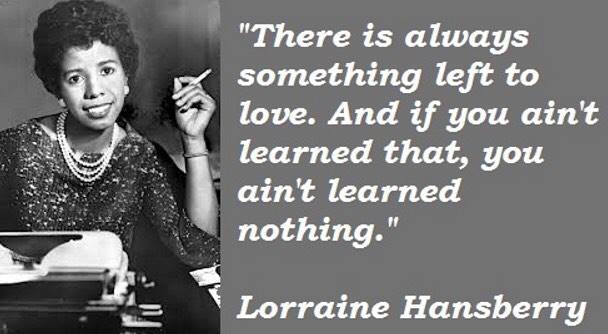
“Black” was the racial description handwritten on Lorraine Vivian Hansberry’s birth certificate on May 19, 1930. The hospital had printed “Negro”, but Carl and Nannie Perry Hansberry, Lorraine’s parents, crossed out the hospital’s label and asserted the right to designate their child’s racial identity on their own terms. Carl and Nannie raised four children on the South Side of Chicago, Illinois. The granddaughter of a freed slave, Lorraine was the youngest of her four siblings: Carl, Jr., Perry, and Mamie. She was separated in age from her siblings by seven years, she often played alone. In addition, her family’s affluence separated her from her neighborhood peers.
Lorraine Hansberry is the niece of William Leo Hansberry, a profound and famous Howard University professor of African History in Washington D.C. until 1959. William Leo Hansberry also had a college at the University of Nigeria named after him.

“Historian and anthropologist, William Leo Hansberry began his college education at Atlanta University, but (at the urging of W.E.B. DuBois) he transferred to Harvard in 1917. Based on his reading of classical texts and his study of archaeological evidence, Hansberry became convinced as an undergraduate that sophisticated civilizations had existed in Africa–especially in Ethiopia–for centuries prior to the rise of the Greeks and Romans in Europe. He pursued that premise for the rest of his life.”
Lorraine’s father, Carl Hansberry, was a successful businessman who had achieved success in real estate and banking even in the midst of the Great Depression. Her mother, Nannie Perry Hansberry, was a former schoolteacher, was a committeewoman. Lorraine’s parents were intellectuals, activists, and active members of the Republican party.
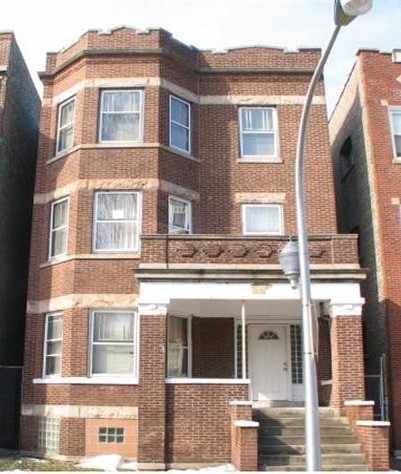
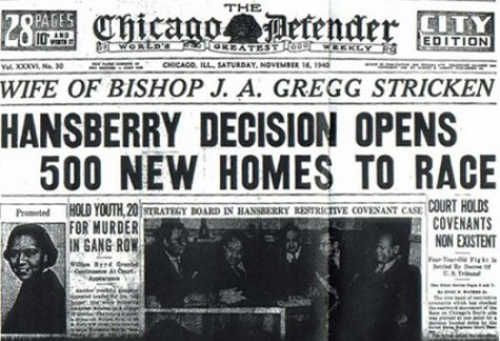 While the Chicago Defender knew the importance of the U.S. Supreme Court’s “Hansberry” decision, most of Chicago’s white (and then, racist) press realized that what the Supreme Court orders for Chicago Chicago can undo. Thus, in the late 1970s, Substance could find property owners on Chicago’s Northwest Side still honoring restrictive covenants that were supposedly declared unconstitutional 30 years earlier — and Chicago had become more segregated than it was when her father’s fight inspired Lorraine Hansberry’s play.
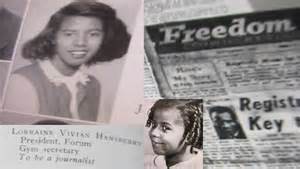
This experience served as a loose inspiration for Lorraine Hansberry’s play A Raisin in the Sun. Lorraine eventually graduated from Englewood High School. “Lorraine graduated high school in 1948, after her graduation Lorraine is said to have studied many areas in many parts of the country, and for that matter the world. Among the places reported include: the University of Chicago, The Art Institute of Chicago, The New School of Social Research in New York, in Guadalajara, and at the University of Wisconsin a predominantly white university, to study journalism, but was equally attracted to the visual arts. She integrated an all-white women’s dormitory and became active in the campus chapter of the Young Progressive Association, a national left-wing student organization, serving as its president during her sophomore year. During her time at the university, she saw a production of Sean O’ Casey’s play Juno and the Paycock about the problems of a downtrodden family in Dublin in 1922. It is supposed to have inspired her most well-known and endearing play A Raisin In The Sun. Lorraine left Wisconsin after two years and moved to New York City in 1950.” Her writing has been shaped by the works of Langston Hughes, William Shakespeare, W.E.B Du Bois, and Frederick Douglass
College and Years of Development: 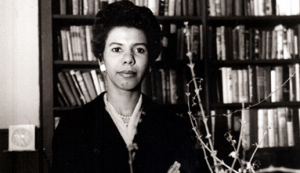 Hansberry initially attended the University of Wisconsin-Madison in 1948. However, she found college uninspiring and left in 1950 to pursue her career as a writer in New York City. She took classes in writing at The New School an institution located in New York City. Lorraine Hansberry also worked as an associate editor for Paul Robeson’s radical black magazine, which was titled Freedom. During this time Hansberry met Langston Hughes, a leader in the Harlem Renaissance, a time period during the 1920s and ’30s that saw an African American movement and development of literature and arts. Langston Hughes’s works would deeply influence Lorraine Hansberry and her theatrical works.
Legendary Playwright Lorraine Hansberry
Legendary Playwright Lorraine Hansberry – Basic Black discusses legendary playwright Lorraine Hansberry, who wrote ‘A Raisin in the Sun.’ Panelists: Lisa Simmons, director of the Roxbury International Film Festival; Tracy Heather Strain, producer of ‘Sighted Eyes/Feeling Heart,’ a documentary about Hansberry; Kim McLarin, associate professor at Emerson College; and Michael Jeffries, associate professor at Wellesley College.