“Loving our state does not mean lying about its history. It means telling the truth — even when the truth is hard.”
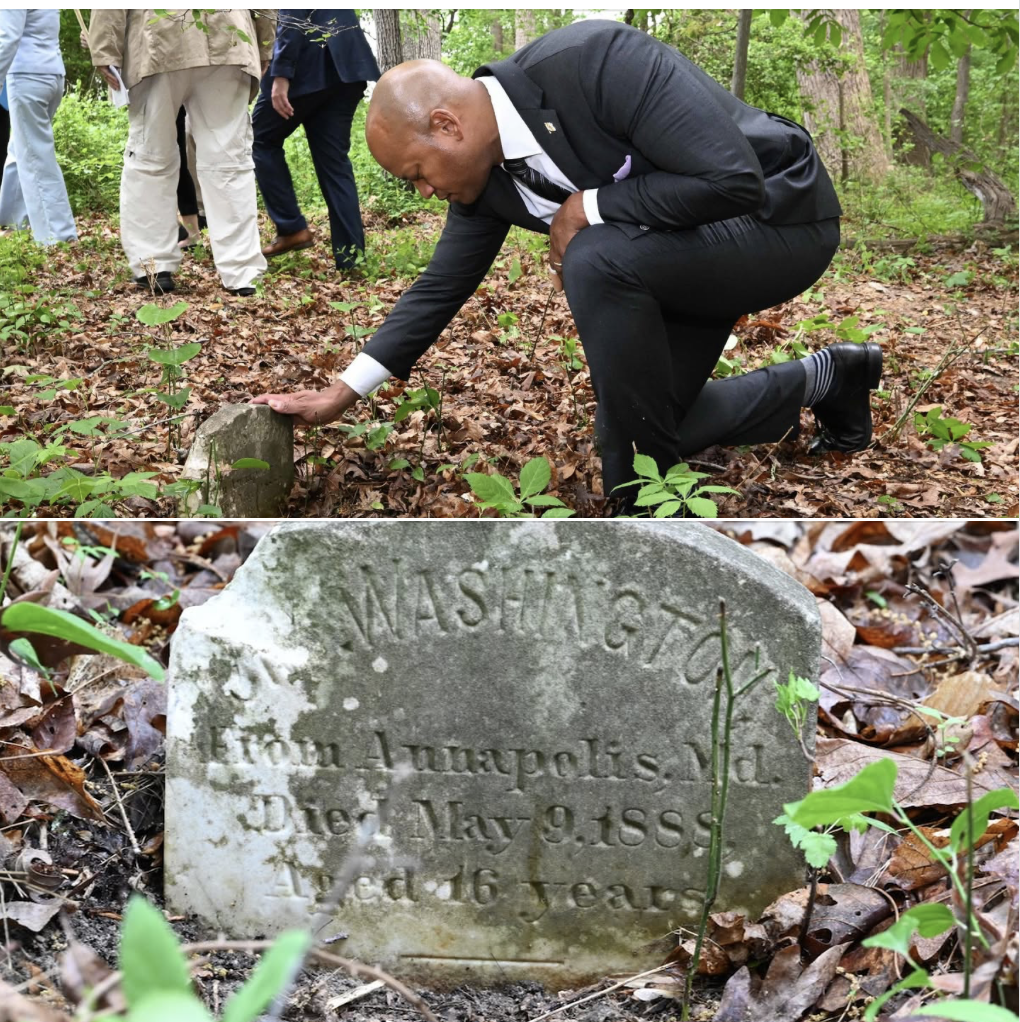
“Today we honored the more than 230 Black boys who died at the House of Reformation and lie in unmarked graves. And today, we announced that we are restoring their burial sites.”
“Their stories deserve justice and their souls deserve eternal peace.“
Westley Watende Omari Moore is the 63rd Governor of Maryland, sworn in on January 18, 2023. – He is Maryland’s first Black governor and only the third African American elected as a governor in U.S. history.
–
“Today is an important reminder that darkness does not win, light does.”
“Here they were whipped and beaten — their humanity taken away from them,”
“Boys died of disease and exhaustion here.”
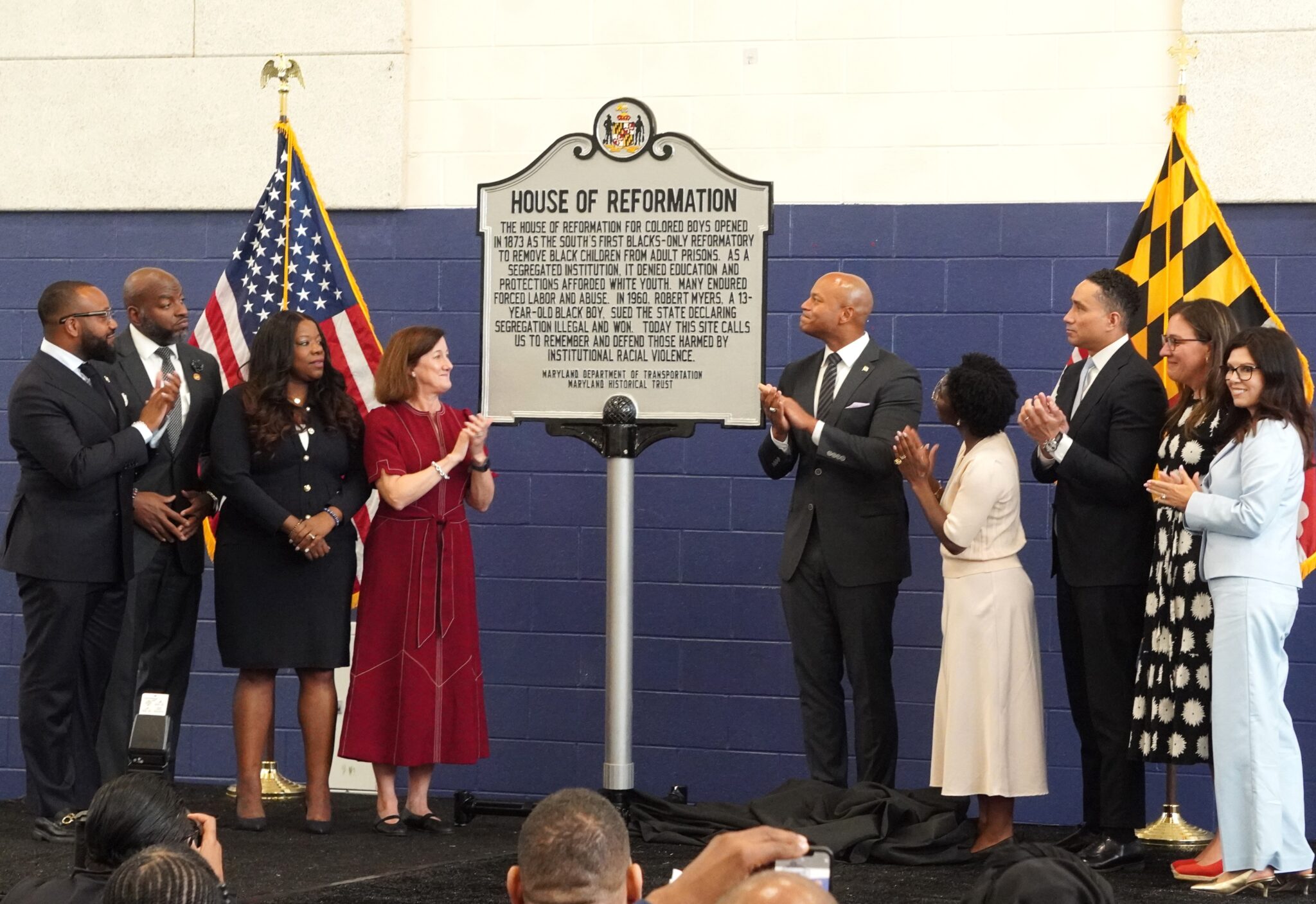
Governor Moore unveiled a roadside marker to officially acknowledge the institutional racial violence and deaths at the site.
State Investigation: Maryland has allocated over $1 million for a commission to conduct forensic analysis and genealogical research to identify the buried children.
Restoration: Efforts are underway to clean up the burial site and restore dignity to the grounds, which sit just yards away from the well-maintained Cheltenham State Veterans Cemetery.
–
Gov. Wes Moore (D), center, looks at roadside historical marker unveiled Wednesday that pays homage to Black youth buried on property at the former House of Reformation and Instruction for Colored Children in Prince George’s County. (Photo by William J. Ford/Maryland Matters)
–
Maryland Governor Wes Moore unveils House of Reformation marker
–
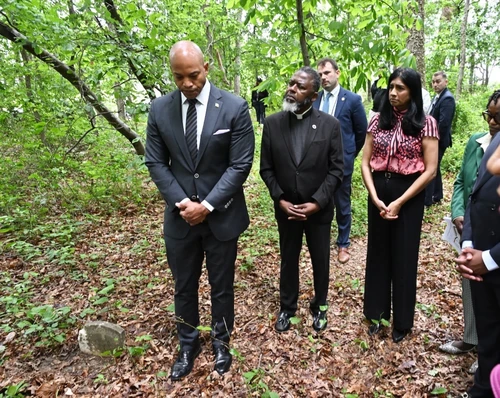
“The state’s newest historical marker recognizes a difficult and often overlooked moment in Maryland’s past,” said Maryland Department of Transportation Secretary Katie Thomson. “The Maryland Department of Transportation, in partnership with the Maryland Historical Trust, encourages the traveling public to reflect and honor the boys from the House of Reformation.” “Now begins the important work of not just uplifting the voices of the young boys who received unequal treatment at this site, but ensuring our agency today is treating the children we serve with the humanity they deserve, so that they may have the space to be held accountable and to learn the skills that help them navigate the difficult situations that lead to crisis and crime,” said Maryland Department of Juvenile Services Secretary Betsy Fox Tolentino. – In his remarks, the governor highlighted the landmark 1961 legal victory in State Board of Public Welfare v. Myers, a case litigated by pioneering attorney Juanita Jackson Mitchell and supported by Thurgood Marshall. The lawsuit, filed on behalf of 13-year-old Robert Myers, successfully applied the principles of Brown v. Board of Education to juvenile facilities, ending de jure segregation in Maryland’s reform schools. The legacies of Robert Myers and Juanita Jackson Mitchell are central to the the Department of Juvenile Services’ “Roots to Rise” initiative, which anchors the state’s youth justice work in historical truth-telling and community partnership to build a justice system focused on empowerment and restoration. Following the unveiling ceremony, Governor Moore led a sacred acknowledgment at the site of the future archaeological project. The solemn gathering included prayer to honor the children buried on the grounds and offer blessings for the restorative work ahead.”
–
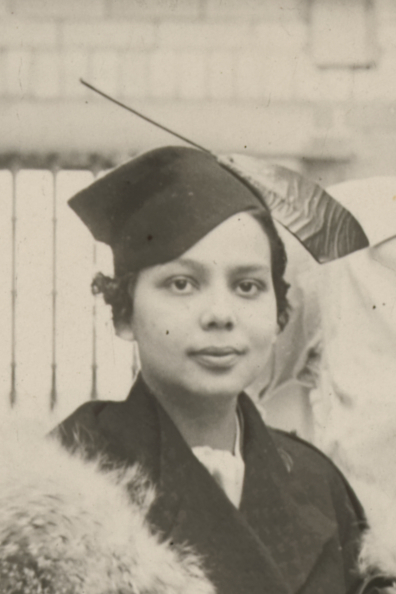
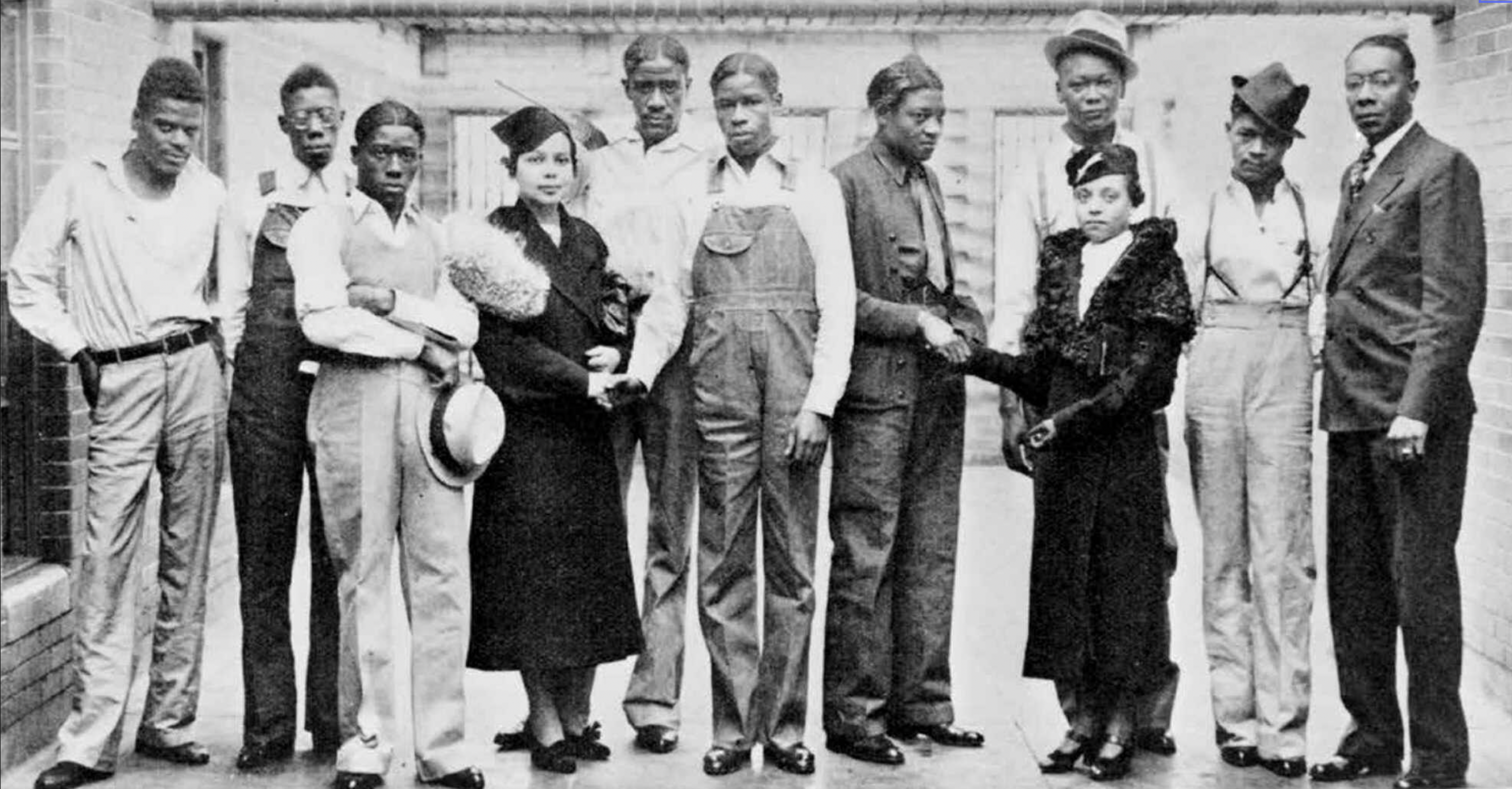
Juanita Jackson Mitchell (1913-1992) was the first Black woman to practice law in the state of Maryland. – Scottsboro Boys and Juanita Jackson Mitchell
–
Juanita Jackson Mitchell was the pioneering attorney who represented Robert Myers in the landmark 1961 case State Board of Public Welfare v. Myers, which successfully ended segregation in Maryland’s juvenile facilities.
Key Details of the PartnershipThe Attorney: Juanita Jackson Mitchell was a legendary civil rights figure.
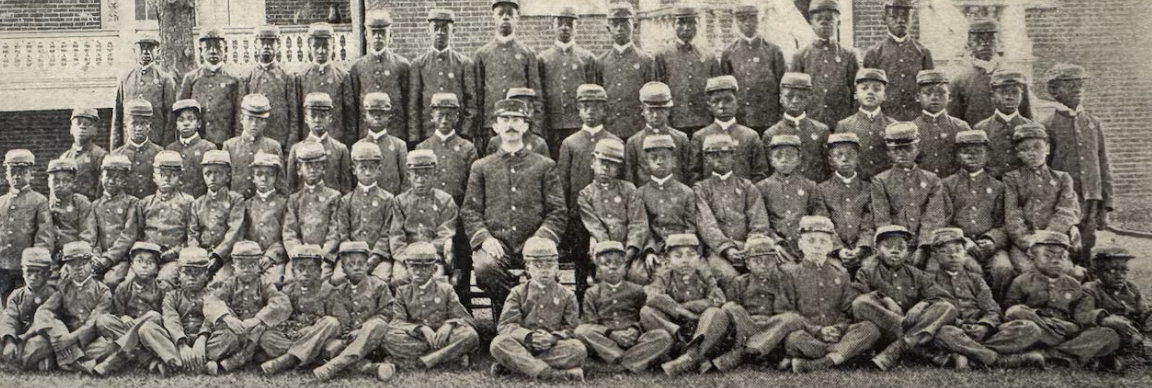
The Client: Robert Myers was a 13-year-old boy detained at the Cheltenham School for Boys (then known as the House of Reformation), a segregated reform school.
The Case: Mitchell and co-counsel Tucker Dearing sued the state, arguing that segregated juvenile housing was unconstitutional.
Their victory forced the desegregation of Maryland’s youth detention centers, marking a major milestone in the state’s civil rights history.
–
Recent news highlights Robert Myers, who was 13 years old when he became the lead plaintiff in a landmark 1961 legal case, State Board of Public Welfare v. Myers.
This lawsuit ended racial segregation in Maryland’s juvenile facilities, applying the principles of Brown v. Board of Education to reform schools. – Historical Significance of Robert Myers Civil Rights Case: In 1960,
Robert Myers sued the state of Maryland while being held at a segregated reform school then known as Boys Village (now Cheltenham).
The legal victory in 1961 successfully integrated these facilities.Legal Support: His case was litigated by Juanita Jackson Mitchell, and was supported by Thurgood Marshall.
Thurgood Marshall
Thurgood Marshall was a pioneering civil rights attorney who became the first African American justice to serve on the U.S. Supreme Court. Before his appointment to the bench, he was the chief architect of the legal strategy that dismantled state-sponsored segregation in the United States. He is most famous for arguing and winning the landmark case Brown v. Board of Education (1954), which declared racial segregation in public schools unconstitutional.
–
Recent Commemoration: On May 7, 2026, Governor Moore of Maryland unveiled a roadside historical marker at the former House of Reformation for Colored Boys to recognize this history and the legacy of Robert Myers.
Personal Legacy: His sister, Janice Griffin, recently attended the ceremony honoring him, noting that her brother did not have a decent life and that his time at the reformatory was difficult.
–
“
Children as Inmates
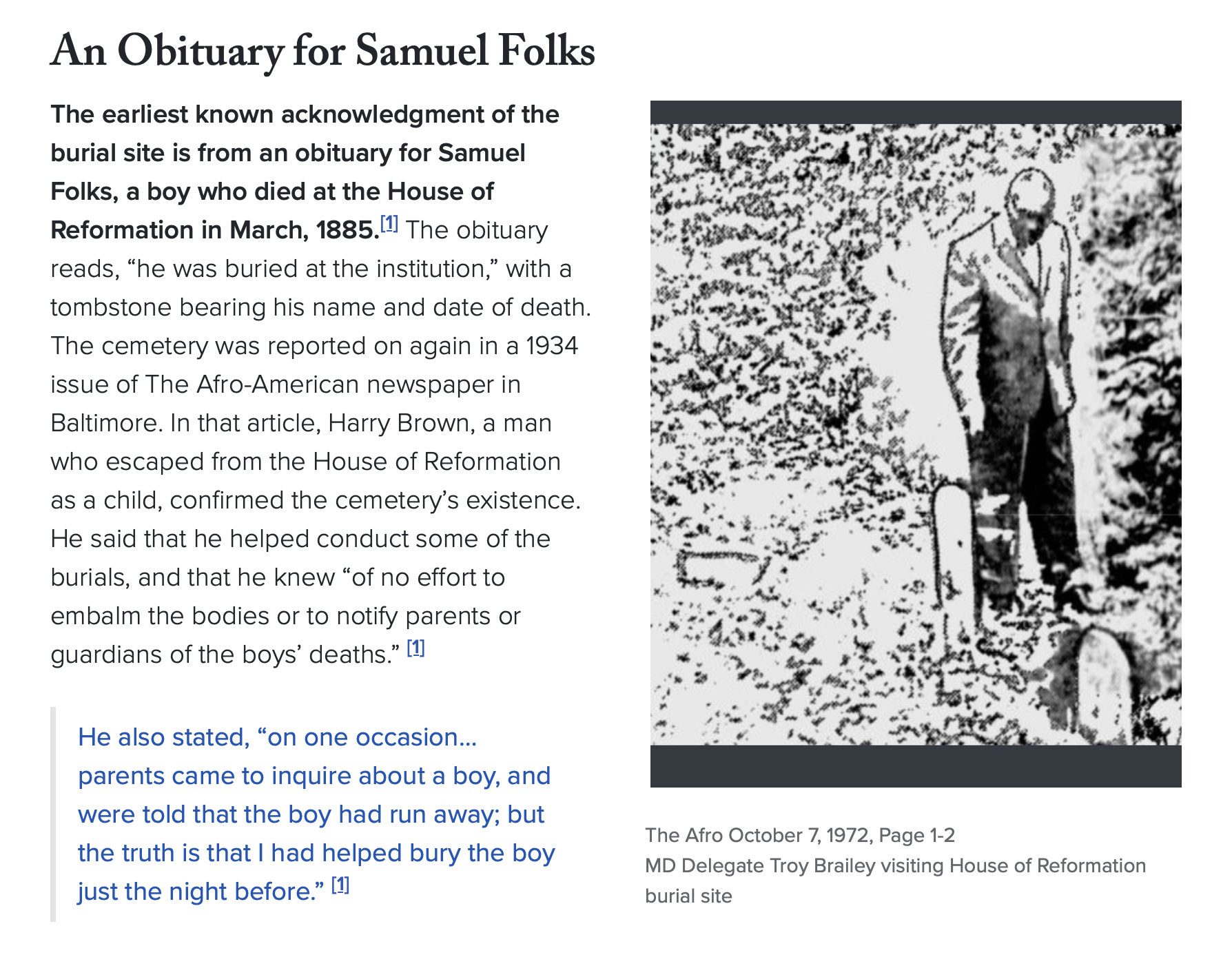
“In addition to the headstones, through information on the “Find a Grave” website (an on-line database owned by Ancestry.com containing cemetery records from around the world), DJS was initially able to catalog the death certificates and obituaries of at least 80 youth who died at the House of Reformation and are likely buried in the burial site. The agency was able to track each youth’s age, county of origin, official cause of death, and parental information. The death certificates almost exclusively refer to incarcerated Black boys as “inmates” and allude to the forced labor that they endured, with many listing “broom shop” and “factory” in the “Occupation” section. [1] Almost all of the death certificates list a disease as the official cause of death, though some also list things like “brick” and “stabbing”.
The most common diseases listed are tuberculosis, pneumonia, typhoid fever, and meningitis. If accurate, this reflects the poor healthcare infrastructure at the House of Reformation, as the facility often lacked medical staff. However, it should not be assumed that the reform school administrators were always truthful about how these children died and news reporting from the time documents deaths that were the result of extreme abuse and neglect.”
The Work Continues
“The existence of the burial ground was publicly announced on July 17, 2025 during a visit to the cemetery by Maryland State Senator Will Smith (Chair of the Maryland Senate’s Judicial Proceedings Committee), Vinny Schiraldi (former DJS Secretary) and Marc Schindler (former DJS Assistant Secretary & Chief of Staff). During the announcement of the existence of the burial ground, Senator Smith also announced that he would be re-filing legislation to reduce the number of youth prosecuted in Maryland’s adult criminal justice system and that he would be holding hearings about the burial ground and the segregationist history of the state’s juvenile justice system.”
–
Samuel Folks
Harry Brown
Center for Youth Justice – [1] Crystal Foretia / Maryland Department of Juvenile Services, Boy’s Village Cemetery Project (African American Heritage Preservation Program Grant Application, June 2025).
ARCHIVIST, EDUCATOR, HISTORIAN, and ARTiST
Dale Ricardo Shields is highly accomplished African American actor, director, producer, and educator with a distinguished career in theatre and academia.
Here's a summary of his background and achievements:
Early Life and Family:
Born on November 4, 1952, in Cleveland, Ohio.
His family has a strong musical background; his grandfather and father were founding members of the Shields Brothers Gospel Quartet of Ohio, and his mother was part of the Turner Gospel Singers.
He is a cousin of boxing promoter Don King.
Education:
Graduated from John F. Kennedy High School in 1970.
Holds both a BFA (1975) and MFA (1995) from Ohio University.
Career and Contributions
Theatre Professional:
Actor: Has appeared on Broadway, Off-Broadway, Off-Off-Broadway, and in regional productions. His television credits include The Cosby Show, Another World, Guiding Light, Saturday Night Live, and the ITV series Special Needs. He has also appeared in commercials and films.
Director and Stage Manager: Has extensive professional credits in these roles, including projects at Lincoln Center, The Henry Street Settlement House (New Federal Theatre), The Negro Ensemble Company, and The Joseph Papp Public Theatre.
Assistant Director: Served as assistant to Lloyd Richards and assistant director for the New Federal Theatre premiere of Ossie Davis's play A Last Dance With Sybil starring Ruby Dee and Earl Hyman.
Educator:
Professor: He is a Professor of Acting, Directing, Black Theatre, Black Studies, and Stage Management. He has taught at various institutions, including Ohio University, The College of Wooster, Denison University, Macalester College, Susquehanna University (as artist-in-residence), and SUNY Potsdam.
Workshops and Programs: Conducted workshops for Joseph Papp's Playwriting in the Schools Program (PITS) at The Public Theatre for six seasons and represented the United States at the ASSITEJ Theatre Festival in London, England, in 1988.
Artistic Activist and Historian:
Iforcolor.org: Creator and archivist for the Black History website Iforcolor.org, dedicated to preserving and sharing information about African Americans and artists of color. He also maintains the "Black Theatre/African American Voices" website on Facebook.
Project1VOICE Liaison: Serves as the Project1VOICE Liaison for the state of Ohio, directing "One Play One Day" events in Cleveland since 2011.
Awards and Recognition:
The Kennedy Center/Stephen Sondheim Inspirational Teacher Award: Recipient in 2017.
Paul Robeson Award: Recipient in 2021 (jointly presented by the Actors' Equity Association and Actors' Equity Foundation).
AUDELCO/"VIV" Special Achievement Award: Received in 2017.
Tony Award Nominee: Nominated for the "Excellence in Theatre Education Award" in 2015 and 2017.
Ebony Bobcat Network (EBN) Legend Award: Received from Ohio University in 2022.
ENCORE AWARD / The Actors Fund: Received in 2020, 2021, 2022, and 2024.
Outstanding Professor Awards: Has received two of these and three "Educational Program of the Year" awards as a university professor.
The HistoryMakers archives: Interviewed and included in The HistoryMakers archives, permanently housed in the Library of Congress.
Dale Ricardo Shields is recognized for his profound impact on the lives of his students and his unwavering dedication to preserving and promoting Black theatre history and culture.